
Forget Elections
You cannot have a functioning democracy in a country that never learned how to think. Not declined — never started. Emotion will always beat evidence when $10.5 billion is paid to make sure it does.

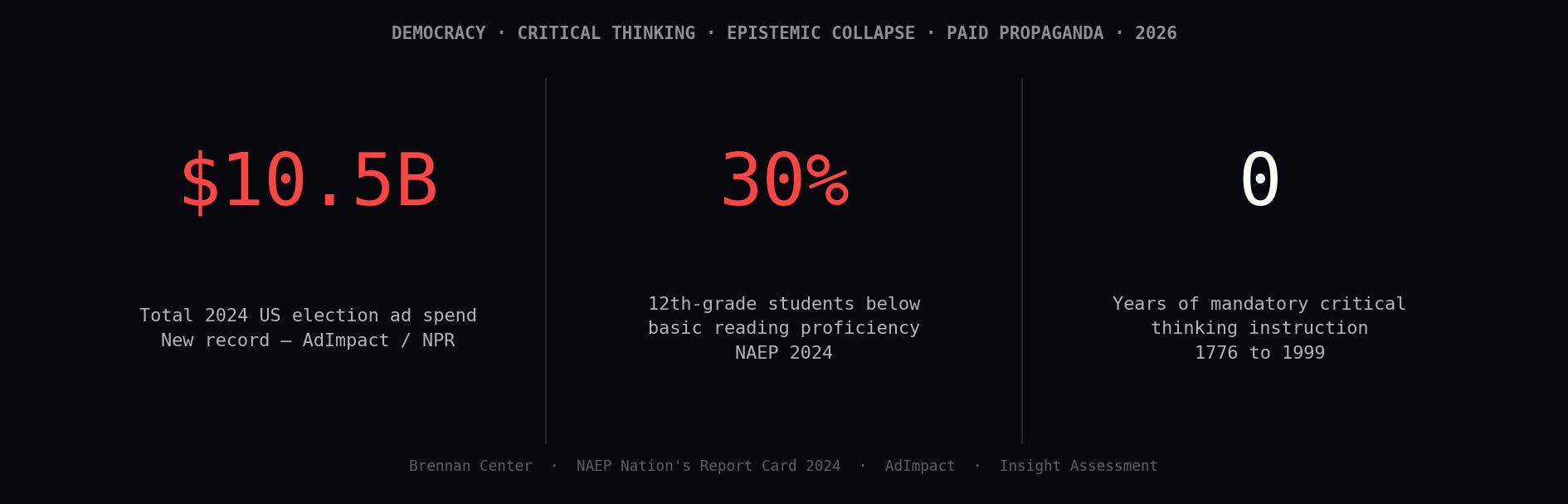
The problem is not that Americans stopped thinking critically. The problem is that they never started. There was no golden age of American epistemic virtue that we are now watching decay. There was always this — a population trained from birth to substitute authority for evidence, to treat the loudness of a conviction as proof of its truth, and to mistake the performance of skepticism for the discipline of it.
What changed is not the capacity of the population. What changed is the price of exploiting it. In 2024, the total bill for political advertising in the United States hit $10.5 billion — a new record, a 24% increase over 2020, and the most precisely engineered campaign of emotional manipulation in the history of democratic elections.1 Not argument. Not evidence. Manipulation. The industry knows the difference. It chose the latter because the latter works.
It works because a population that cannot evaluate evidence on its merits has no defense against a sufficiently well-funded appeal to fear, identity, and tribal loyalty. The $10.5 billion is not a cause of American epistemic failure. It is a bet on it. And every election cycle, the bet pays.
I What Critical Thinking Actually Is
The phrase has been so thoroughly colonized by its enemies that it requires rescue before use. When American schools began teaching “critical thinking” around 2000 — and the timeline is accurate, mandatory instruction in evidence-based reasoning was not a significant feature of American K–12 education before then — what most of them actually taught was debate skills. How to argue any side of any question with equal facility. How to construct a persuasive case. How to win.
This is not critical thinking. It is rhetoric. And the distinction matters enormously.
What Critical Thinking Actually Requires · Four Components
1. Evidence standards
What counts as evidence. What doesn’t. How to evaluate the difference. Not taught. Most Americans cannot distinguish peer-reviewed research from a Facebook post, a think tank white paper from a scientific consensus, or an anecdote from a data point.
2. Logical structure
Identifying valid inference. Recognizing fallacy. Not taught. The American educational system has never systematically taught formal logic, argument mapping, or fallacy identification at the K–12 level.
3. Self-application
Applying the same evidential standards to your own beliefs that you apply to others’. Not taught. The American rhetorical tradition explicitly trains the opposite — how to defend your position, not how to honestly evaluate it.
4. Updating
Actually changing your position when the evidence requires it. Culturally penalized. American political and religious culture treats changing your mind as weakness, flip-flopping, or apostasy — depending on the context. The person who updates on evidence loses status. The person who holds firm regardless of evidence gains it.
The fourth component is the one that kills democracy. A person who cannot update on evidence cannot be persuaded by reality. They can only be activated by identity. And identity is exactly what $10.5 billion in political advertising is optimized to trigger.
II The Formation System
American epistemic failure is not a recent curriculum problem. It is a 250-year formation system that runs through three interlocking institutions: the church, the school, and the media. Each one trains a specific epistemic vice. Together they produce a population that is genuinely, comprehensively unprepared to govern itself.
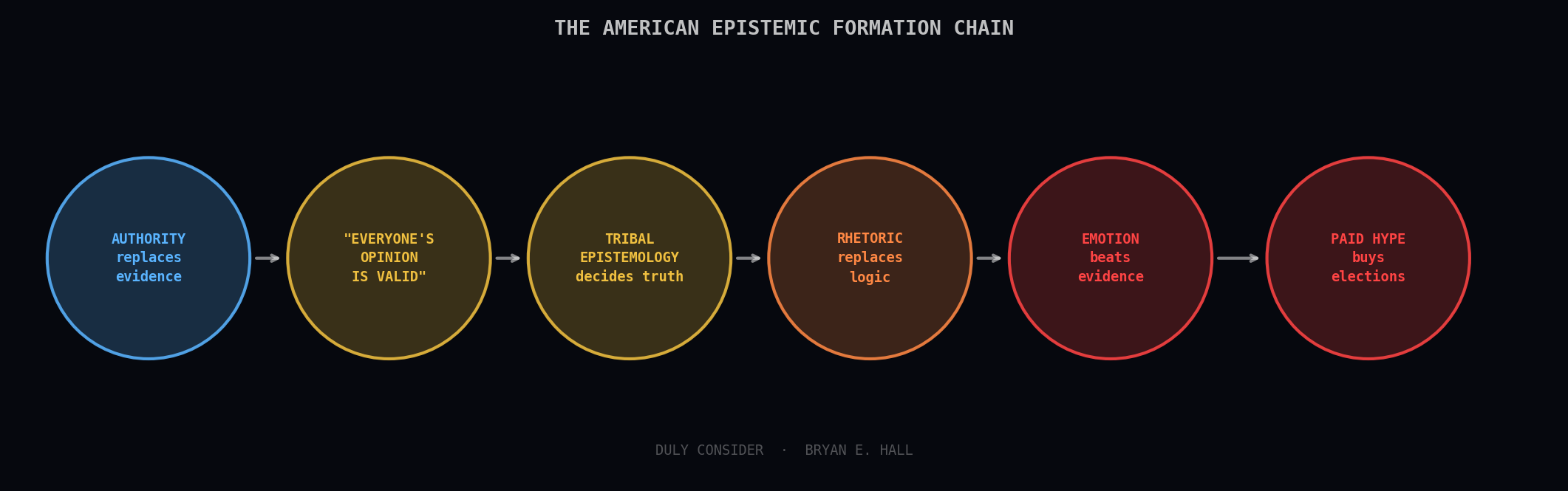
The chain is not a conspiracy. It is a system. Each link reinforces the next. Authority substitutes for evidence. “Everyone’s opinion” collapses epistemic standards. Tribal loyalty determines truth. Rhetorical training replaces logic. Emotion overwhelms evidence. Money buys the outcome.
The church’s contribution is the most underexamined. American evangelical Christianity — the dominant epistemic institution for a substantial fraction of the population — trains a specific and highly transferable rhetorical system: persuasion as the goal of argument, emotional resonance as evidence, the closed epistemic loop of self-validating faith, and tribal solidarity as the ultimate arbiter of truth. The purpose of a church argument is not to find out what’s true. It is to defend what you already believe and to win the convert. These are not compatible with critical thought. They are its mirror image.
What makes this politically catastrophic is that the rhetorical system transfers perfectly outside religion. Replace “the Bible says” with “the Constitution says” or “common sense says” or “everyone knows.” Replace the pastor with the talk radio host. Replace the congregation with the Facebook group or the cable news tribe. The epistemology is identical. The conclusions are tribal. The evidence is whatever your authority figure told you it is.
The school’s contribution is the “everyone has a right to their opinion” doctrine — the most destructive sentence in American intellectual life. It sounds egalitarian. It is epistemically catastrophic. It conflates two things that are not the same:
The right to hold an opinion is a civil right and should be absolute. The right to have your opinion treated as equally valid regardless of its evidential basis is an epistemic claim and is simply false. Collapsing these two distinct propositions into one is not tolerance. It is the deliberate destruction of the concept of truth.
You have an absolute right to believe the earth is flat. That right deserves civil protection. It does not deserve epistemic respect. The opinion is wrong. The evidence against it is overwhelming. Your right to hold it changes nothing about its truth value. But American education has spent generations teaching children that all opinions are created equal — that to challenge someone’s belief on evidential grounds is a form of disrespect, even aggression. The result is a population that cannot be corrected. Which is, for the people who fund elections, exactly the point.
III The Specific Pathology of American Authority
Here is the paradox that explains American politics: Americans believe themselves to be uniquely independent-minded. They celebrate skepticism of authority as a national virtue. And they are among the most authority-dependent populations in the developed world.
The paradox resolves when you understand what American “independence” actually means. It does not mean the capacity to evaluate claims on evidence independent of any authority. It means the capacity to reject one authority in favor of another. You reject the Catholic Church — and accept the evangelical pastor. You reject mainstream media — and accept Tucker Carlson. You reject “the elites” — and accept whatever your ideological tribe’s authority figures say. The authority-dependence is constant. Only the authority changes.
This pattern has roots in the specific Protestant epistemology the country inherited at its founding. Anti-authoritarian in religious terms — no Pope, no hierarchy between individual and God. Deeply authoritarian in social terms — the Bible is the unchallengeable text, the pastor interprets it, the congregation receives it. What this produced was not intellectual independence. It produced a population skilled at the performance of independence while practicing submission.
For electoral politics, this is ideal. You do not need to persuade such a population with evidence. You need to become their authority, or to discredit the authorities they currently trust and position yourself as the alternative. $10.5 billion buys a lot of authority. It buys far more than any amount of evidence could.
IV The Numbers Are the Argument
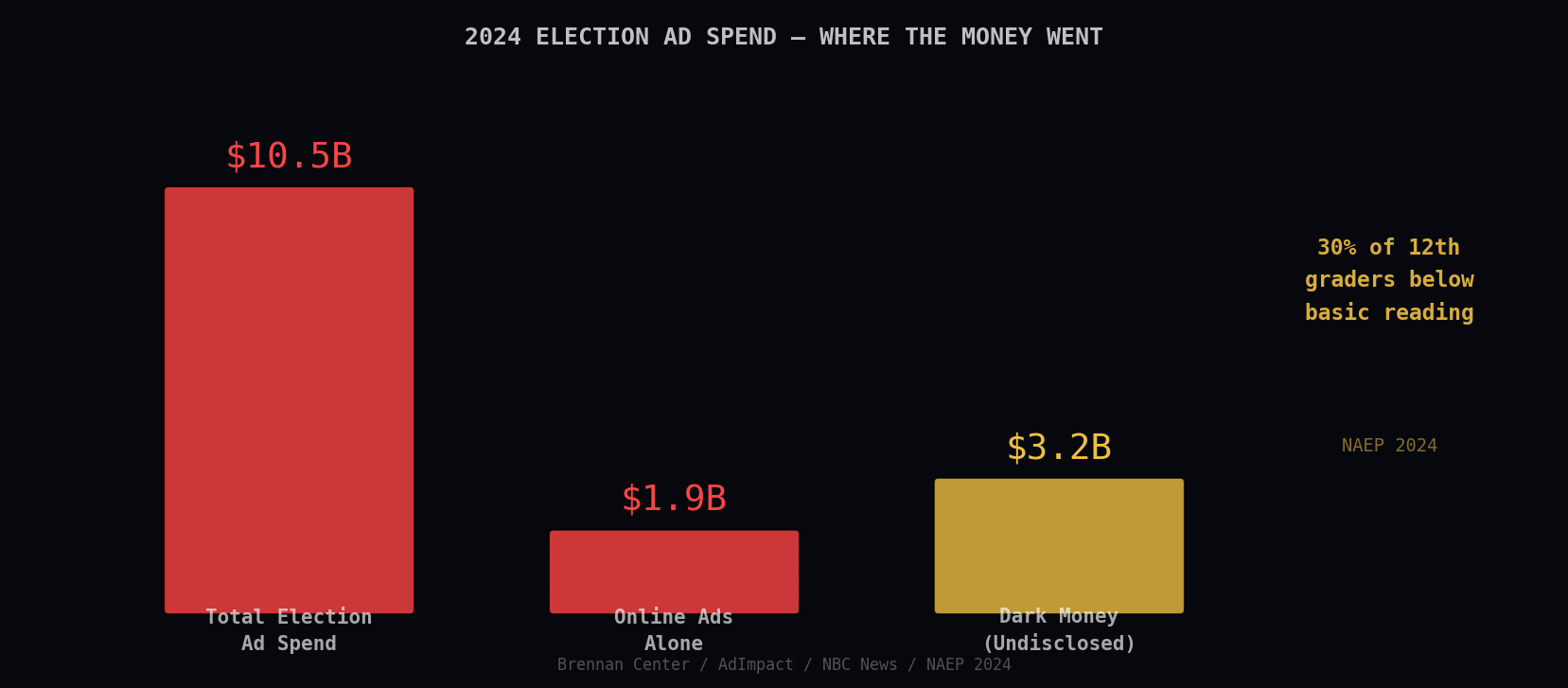
$10.5 billion in total election ad spend in 2024. $1.9 billion in online advertising alone — the most comprehensive accounting to date, and still an underestimate because no law requires full disclosure. Meanwhile: 30% of 12th-grade students below basic reading proficiency. The money knows exactly what it is buying.
The 2024 election cycle spent $10.5 billion on political advertising — a record, up from $9 billion in 2020 and climbing.1 The $1.9 billion in online advertising tracked by the Brennan Center, OpenSecrets, and the Wesleyan Media Project is the most complete accounting available, and it is explicitly an underestimate: no law requires platforms to disclose all political spending, influencer payments are entirely untracked, and dark money flows through channels that report nothing.2
At the same time, the 2024 NAEP “Nation’s Report Card” reported the lowest 12th-grade reading scores in three decades, with 30% of students lacking basic reading proficiency.3 College faculty report that current students are less prepared in critical thinking, reading, and analysis than pre-pandemic students — and the trend preceded the pandemic.4 Employers report graduates lack critical thinking, communication, and problem-solving skills.5
These numbers are not in tension. They are the same fact described from two angles. The political advertising industry spends $10.5 billion precisely because a population with 30% basic reading deficiency and no systematic training in evidence evaluation is an extraordinarily profitable target. The returns on emotional manipulation exceed the returns on argument. The industry knows this. It has always known this. The money is not the cause of the problem. It is the proof that the problem exists and has always existed and has never been seriously addressed.
Democracy requires a citizenry capable of evaluating claims on evidence. The United States has never had such a citizenry at scale. What it has had is a $10.5 billion industry optimized to ensure that it never does.
V Why the 2000 Baseline Matters
The observation that mandatory critical thinking instruction did not become a significant feature of American K–12 education until around 2000 is precisely correct — and the reasons it took that long are revealing.
American public education resisted systematic critical thinking instruction for most of the 20th century for reasons that were not accidental. Teaching children to evaluate claims on evidence rather than on authority is genuinely destabilizing to institutions that depend on authority-based compliance — churches, corporations, political parties. These institutions had strong incentives to resist it and did. The result is that the first generation of Americans receiving even nominal instruction in evidence-based reasoning did not enter adulthood until the early 2000s. They graduated into a media ecosystem being destroyed by the internet and a political advertising system entering the most expensive and sophisticated period in its history.
The timing was not coincidental. The introduction of nominal critical thinking education and the explosive growth of paid epistemic manipulation happened simultaneously. The manipulation outspent the education by orders of magnitude. And the education was itself corrupted almost immediately — “critical thinking” in American schools frequently became debate training, which is the rhetorical art of defending any position regardless of its truth value. The system produced people who are better at arguing and no better at knowing when they are wrong.
VI What This Means for Elections
The verdict is not comfortable.
The Structural Reality · Democracy Without Epistemology
A population that cannot evaluate evidence on its merits cannot make evidence-based political decisions. It can only make identity-based ones. Elections become tribal loyalty contests.
A $10.5 billion political advertising industry exists specifically to ensure that elections remain tribal loyalty contests. It is not a side effect of the system. It is the system.
The “everyone has a right to their opinion” doctrine makes it impossible to correct factually false political claims. A population trained to treat epistemic correction as aggression cannot be informed against its will.
The authority-dependence structure means that the question in every election is not “what do the facts support” but “which authority does my tribe currently trust.” Paid advertising buys authority far more cheaply than it buys facts.
The result is not a failed democracy. It is a democracy operating exactly as its information environment has always dictated it would — as a sophisticated mechanism for converting tribally organized emotion into political power, with the faction best able to fund that conversion winning most of the time.
The answer is not despair and it is not cynicism. The answer is the same answer it has always been: documentation, naming, the refusal to pretend that what is happening is something other than what it is. The Muckrakers did not stop because Standard Oil was too powerful. The civil rights lawyers did not stop because the law was unjust.
But the work has to start with the honest assessment: there is no quick fix for a 250-year epistemic formation system. No single election, no single curriculum change, no single court ruling restores a critical thinking capacity that was never built at scale. What can be built, slowly, over time, against the grain of the entire paid-hype apparatus, is a population that is incrementally less susceptible — that has incrementally better tools for recognizing when it is being manipulated, and incrementally more willingness to update when the evidence requires it.
That is a generational project. It has never had a fraction of the funding that the manipulation apparatus has. It will not win in the next election cycle or the one after that. But it is the only project that matters, because everything else — the accountability journalism, the prosecution gap investigations, the restored consent decrees, the Sentinel Compact — all of it depends on a citizenry that can look at evidence and reach conclusions that are not simply the conclusions their paid authorities told them to reach.
Forget elections, for the moment. The prior question is whether Americans can learn to think. The prior answer is that they were never taught. The prior project is teaching them. The clock on that project started two hundred and fifty years ago. The money has always been on the other side. The work continues anyway.
References
NBC News / AdImpact. (November 8, 2024). The final price tag on 2024 political advertising: Almost $11 billion. Total 2024 cycle ad spend: $10.5 billion, a record and a 24% increase from 2020. Presidential race alone: more than $3 billion. Democrats and pro-Democratic groups: ~$1.8 billion; Trump and pro-Republican groups: ~$1.4 billion.nbcnews.com — 2024 political ad spend final total
Brennan Center for Justice / OpenSecrets / Wesleyan Media Project. (2025). Online Ad Spending in 2024 Election Totaled at Least $1.9 Billion. Analysis of Google, Meta, Snap, and X spending data — acknowledged underestimate due to absence of disclosure requirements. Dark money “continues to shatter records.” Influencer payments “not treated like traditional ad buys and not required to be disclosed.” Russian operatives funneled $10 million to Tenet Media for right-wing influencer promotion.brennancenter.org — 2024 online ad spend analysis
National Assessment of Educational Progress (NAEP). (2024). Nation’s Report Card — 12th Grade Reading and Mathematics. Lowest 12th-grade reading scores in three decades; 30% of students lacking basic proficiency. Math results equally grim — nearly half of seniors struggled with fundamental operations.nationsreportcard.gov — NAEP 2024 results
Center on Reinventing Public Education (CRPE). (September 2025). Fast Facts: The State of the American Student 2025. College faculty: current students less prepared in critical thinking, reading, and analysis compared to pre-COVID students — a trend that preceded the pandemic.crpe.org — State of the American Student 2025
PublicSchoolReview.com. (2025–2026). Failures of U.S. Public Education. Employers increasingly report graduates lack critical thinking, communication, and problem-solving skills. National adoption of evidence-based reasoning instruction “remains slow.” Mismatch between what schools teach and what workplaces demand.publicschoolreview.com — US education failures 2025
Insight Assessment. (2024). What the Critical Thinking Data Tell Us: K–12 Education. “Any previous debate should cease as to whether growth in critical thinking is an automatic result of any effective K–12 educational program. The data is clear in this regard. It is not.” Critical thinking does not emerge automatically from standard curriculum; requires explicit, systematic instruction.insightassessment.com — critical thinking K-12 data
Duly Consider covers politics, science, technology, and philosophy without apology.
© 2026 Bryan E. Hall · bryanehall.substack.com