
The Laugh That Stops
On Epstein jokes, the quiet part out loud, and what happens when the punchline is true — a discussion of what humor does that solemnity didn’t, and where the line actually belongs.

Duly Consider · Politics · Science · Tech · Philosophy
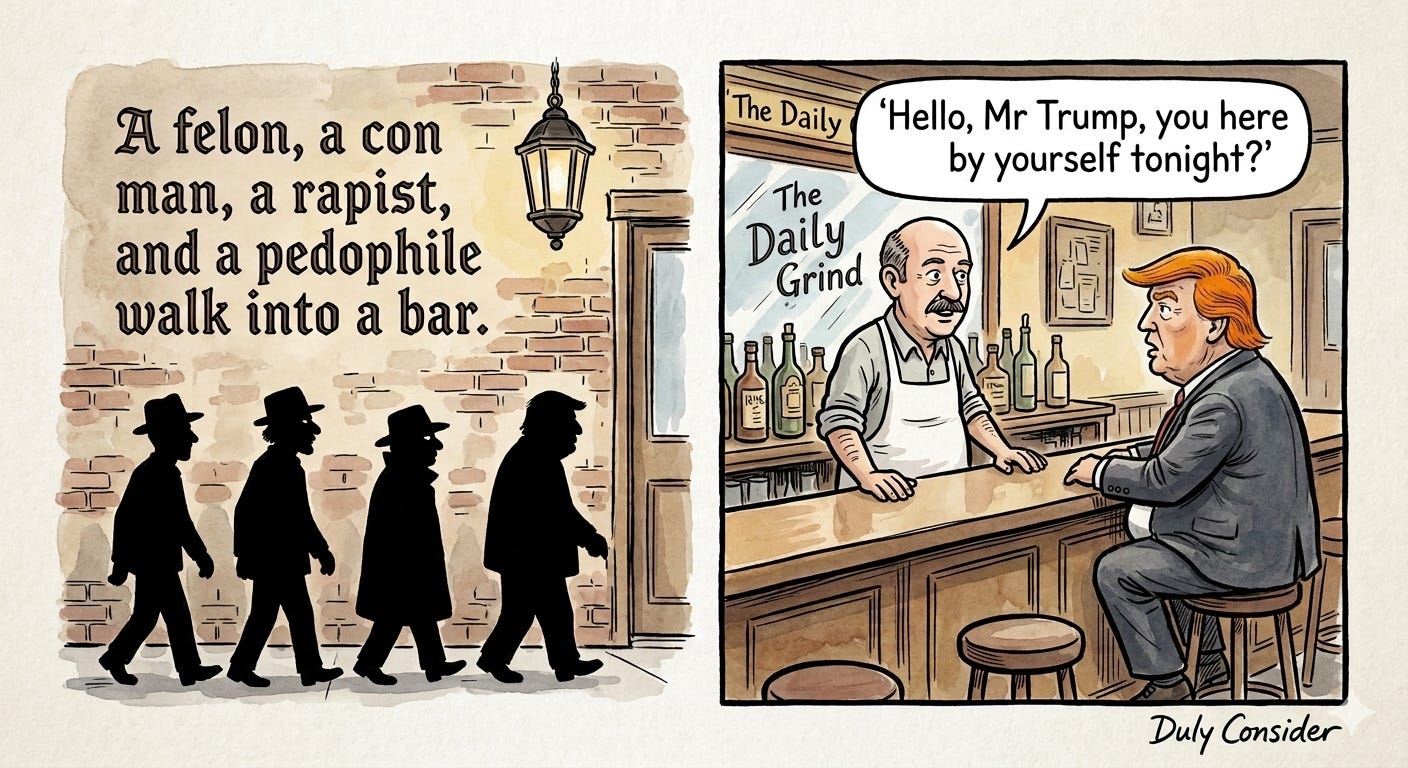
Let’s establish the permission slip at the top and then never mention it again.
Humor about Jeffrey Epstein is not disrespectful to the victims. Silence about Jeffrey Epstein is disrespectful to the victims. We know what the silence produced: a 2008 non-prosecution agreement giving Epstein 13 months in county jail with work release six days a week, immunity from federal prosecution for himself and unnamed co-conspirators, and a requirement — later ruled illegal by a federal judge — that the victims not be notified. We know what the silence produced after that: Epstein’s continued operation, access, flights, guest lists, and White House visits, until 2019. We know what the silence produced after that: a body in a federal facility, two broken neck bones consistent with strangulation, cameras that malfunctioned, guards who were asleep, a ruling of suicide, and sealed files.2, 3, 5
The silence had its chance. If your position is that humor is inappropriate because the subject demands solemnity, you are required to explain what the solemnity got us. The documented record is the answer. Solemn. Thorough. Accountable to no one.
The jokes, then.
Context
What the Silence Produced
2002 – 2026 · The Official Register · The Accountability Gap
Before the jokes can land — or not land — the reader needs the sequence. Not as background. As the thing the jokes are about.
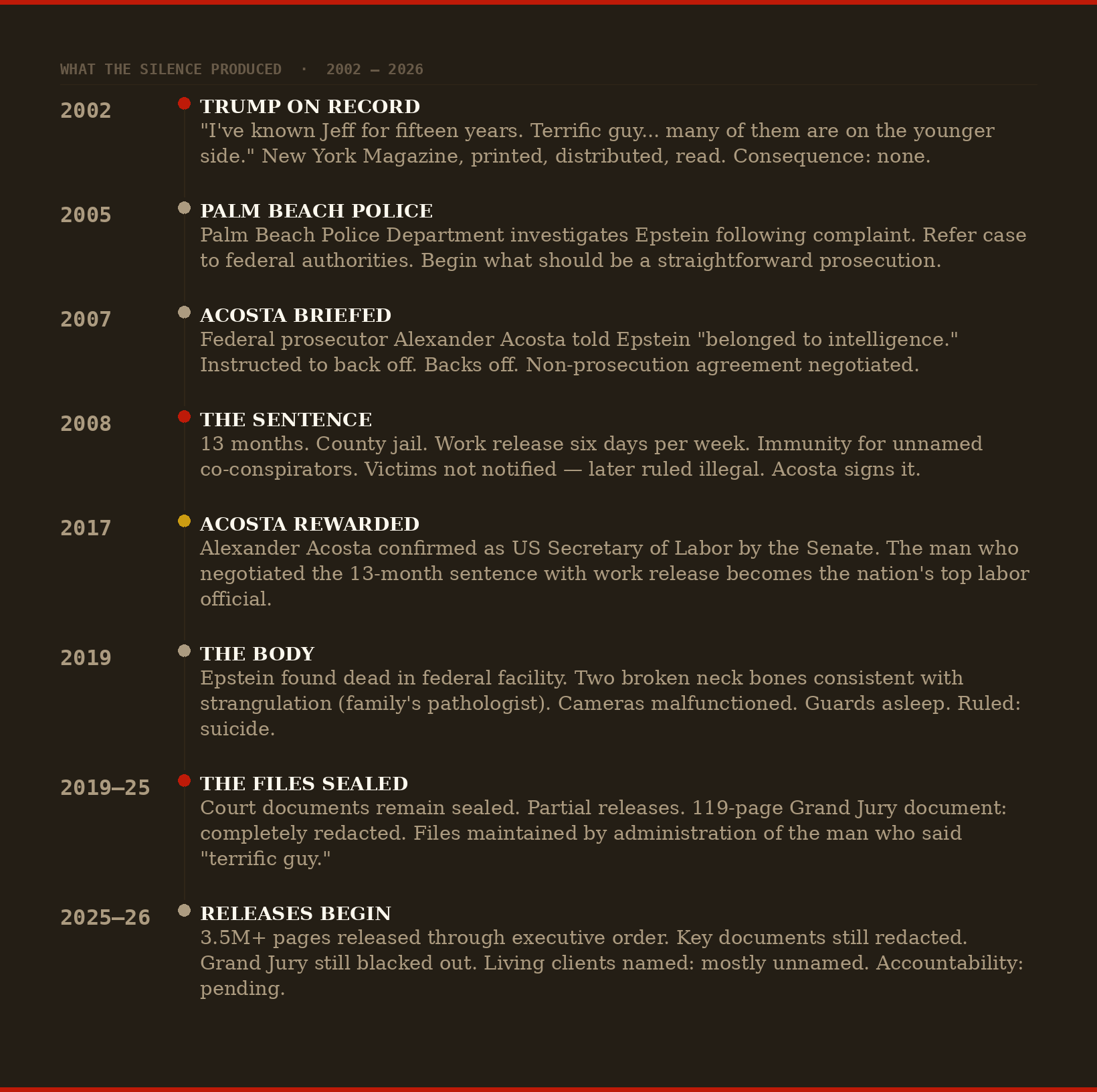
Sources: Miami Herald · Vox · The Daily Beast · NPR · Wikipedia Epstein Files · 2002–2026
The timeline is the permission slip made visible. Every entry is the official, solemn, serious record of what institutions did when they encountered Jeffrey Epstein. The result of that record — across two decades, across multiple federal jurisdictions, across two administrations — is that most of the people whose names are in his contact list remain unnamed in any prosecutorial document. The silence was not respectful. It was operational.
Part One
The Quiet Part Out Loud
Trump 2002 · What the Room Heard · What the Room Did
The specific register we are discussing — the joke that doesn’t land, the laugh that stops — requires the quiet part out loud as its mechanism. The quiet part out loud is when something true is said in public, in the register of the loud part, and the room treats it as unremarkable. The darkness arrives not from the statement but from the room’s reception of it.
“I’ve known Jeff for fifteen years. Terrific guy. He’s a lot of fun to be with. It is even said that he likes beautiful women as much as I do, and many of them are on the younger side.” — Donald Trump, New York Magazine, 2002. Printed. Distributed. Read. Consequence: none.
Here is where the laugh starts and stops.
It starts because the gap between what that sentence says and what we now know it means is so wide, so documented, so entirely available — and yet it was said and produced nothing — that some part of your brain reaches for the laugh as the only available response to a reality that has refused to be real.
It stops because the man who said it in 2002 is now the President of the United States. And the files that would tell us what “many of them are on the younger side” meant in specific, documented, prosecutable terms are maintained, redacted, and selectively released by the administration of the man who said it.1, 6
The quiet part was said out loud in 2002. The room treated it as the loud part. That is not a joke. That is the joke not landing. That is the specific cognitive experience of encountering a truth that the official world has decided not to process — the laugh that starts and then stops because the thing you were about to laugh at is still happening.
Part Two
The Jokes, In Context
Five Jokes · Each One Placed · The Weight That Arrives After
What follows is not a list of Epstein jokes. It is five specific moments of humor, placed inside the documented context they belong to, where the laugh arrives and then something else arrives behind it. The reader cannot escape into the laugh because the next sentence names what the laugh is about.
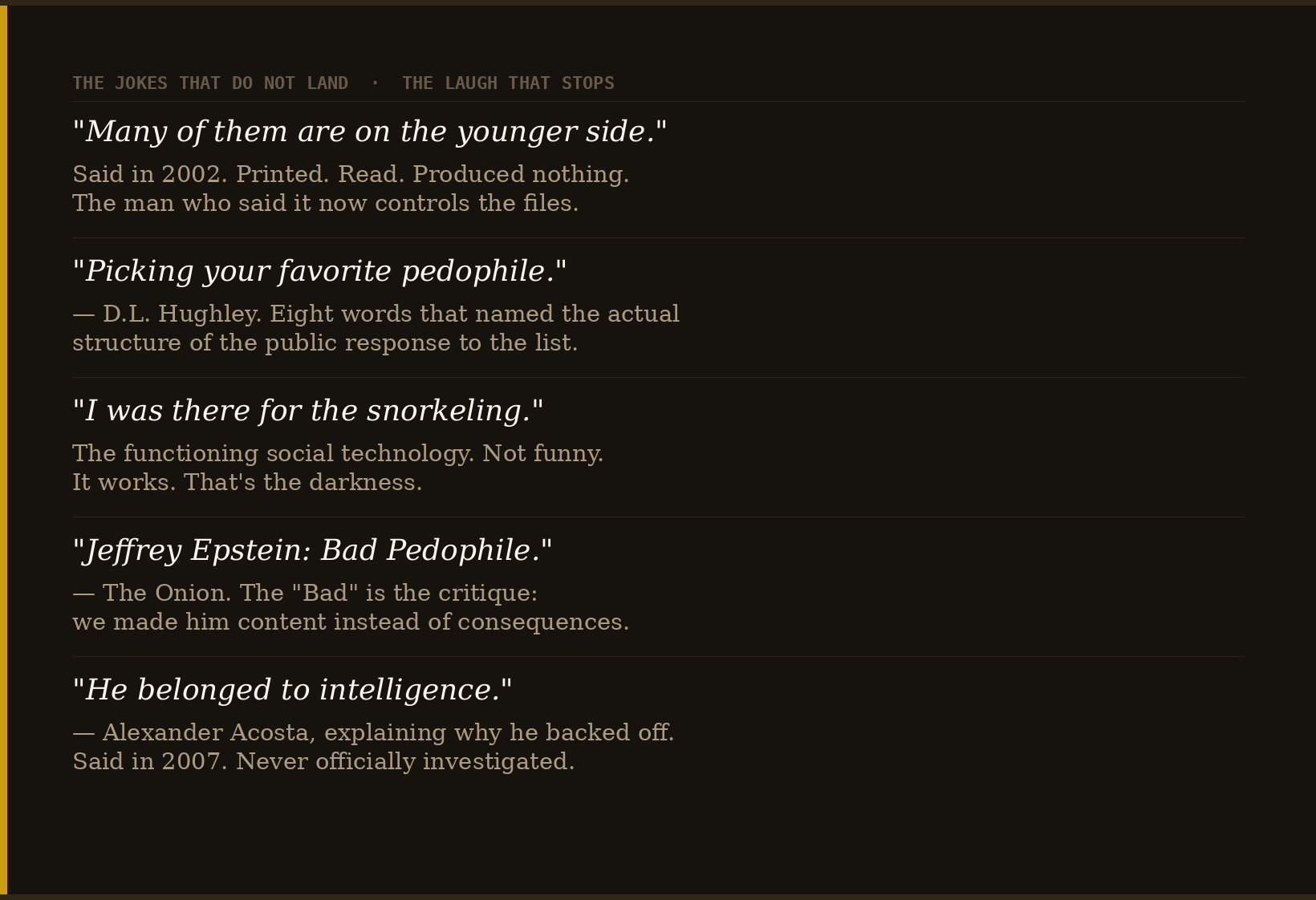
“Many of them are on the younger side.” Said in 2002. Printed. The room heard it. The room moved on. The laugh that arrives when you read it now — the laugh of recognition, of exhausted absurdity — stops the moment you remember that the man who said it now controls the files. The joke is the gap. The gap is the accountability. The accountability is what we have instead of the arrests.1
“Picking your favorite pedophile.” D.L. Hughley, looking at the public response to the Epstein files, named the actual structure of it in eight words. The laugh arrives because he’s right. It stops because when you follow the logic — that a significant portion of the public has, in fact, organized its response to documented child sex trafficking around which of the named men is least likely to be their guy — you have an accurate description of American political culture’s relationship to the Epstein case. Accurate descriptions of real phenomena are not funny. They are just real.9
“I was there for the snorkeling.” The laugh arrives because the defense is absurd. It stops because the defense works. Not legally — not yet, in most cases, because most cases have not been brought. But socially. The men offering the snorkeling defense, in various forms, have continued to occupy positions of prominence. They have continued to be invited to dinners and boards and foundations. The snorkeling defense is a functioning social technology. It was designed to function. It functions because the same institutional power that negotiated the 13-month sentence also maintains the social consensus in which that defense is sufficient. That is not funny. It is the darkness that arrives after the laugh stops.
“Jeffrey Epstein: Bad Pedophile.” The Onion’s mockumentary title. The “Bad” is the joke. The joke is that the culture has been busy evaluating Epstein’s quality as a criminal — the sophistication of the network, the audacity, the mysterious death — while the question of accountability for the living clients remains, for most of them, entirely open. The Onion is making a joke about what happens when accountability failures enter the content economy: they become IP. The laugh stops because Bad Pedophile is accurate. We have been, mostly, the audience.8
“He belonged to intelligence.” Not a comedian. Alexander Acosta, in 2007, explaining to colleagues why he was backing away from what should have been a straightforward prosecution. The quiet part said out loud in a meeting rather than a magazine. Acosta later became Secretary of Labor. The intelligence connection he referenced has never been officially investigated. The laugh that would arrive at that sequence — the laugh of people who have watched the documentation accumulate without proportionate accountability — that laugh doesn’t land either. Not because it isn’t deserved. Because the thing it’s laughing at is still going.4
Part Three
The Psychology of the Absurdity
Why the Laugh Stops · What It Reveals · The Silence as Alternative
The specific cognitive experience of the joke that doesn’t land — the laugh that starts and stops — is the accountability mechanism. It is the moment when the audience realizes they were about to let something go, and the joke refused to let them. That refusal is what makes the form political rather than merely entertaining.
The objection to Epstein humor on grounds of seriousness has not noticed that the seriousness produced nothing. The FBI had the files. The prosecutors had the testimony. The federal facility had cameras. The powerful had names. The solemnity was complete. The accountability was zero. If your position is that jokes are inappropriate because the subject is too serious, you are required to explain what the seriousness got us. The 13-month sentence with work release is the answer. The malfunctioning cameras are the answer. The sealed Grand Jury document is the answer.
The humor that breaks the silence — even awkwardly, even with discomfort, even at the cost of a wince — is doing more accountability work than the silence did. This is not a defense of all Epstein humor. The humor that makes the mechanics of the abuse into the punchline, that treats the victims as a shared cultural reference whose horror has been sufficiently domesticated that it can be played for shock — that humor works in the opposite direction. It produces distance. This publication closes it.
The humor that targets the system — the 13-month sentence, the snorkeling defense, the “terrific guy,” the malfunctioning cameras, the “belonged to intelligence” — that humor is aimed upward. At the institutional failure. At the protected impunity. At the gap between what was documented and what was done about what was documented. That humor belongs here. It is doing the work that the silence refused to do.
The line is direction. Who does the joke land on. What does the audience feel when the laugh stops. Do they feel the weight of the thing or have they been relieved of it. The jokes in this piece — placed inside the documented sequence they belong to, with the weight that arrives after stated immediately — are designed to deny the relief. The reader laughs and then the next sentence is the receipt. That is the form. That is the accountability.
The victims are still in court. Their testimony is still being contested. Their names are still being kept from documents they have been fighting to access for years. The 119-page Grand Jury document is still completely blacked out. The intelligence connection Acosta referenced in 2007 has never been officially investigated. The administration that is managing the file releases is led by the man who said “many of them are on the younger side” in 2002 and called Epstein a terrific guy.
The jokes broke the silence that the official institutions maintained. They broke it incompletely. They broke it in the only register that was available after the official registers had failed. D.L. Hughley said “picking your favorite pedophile” in a comedy set and named the actual structure of the public response more precisely than any Senate hearing has. The Onion called it Bad Pedophile and described the content economy’s relationship to unresolved accountability more accurately than most journalism did. The snorkeling joke made the functioning social technology of the defense visible in the only register where it was being discussed at all.
That is what the humor did. It is not enough. It was never going to be enough. But it is what was done. And the darkness that arrives when the laugh stops — the specific cognitive experience of the joke that names something true and then refuses to let you escape into the laugh — that darkness is the accountability. It is the only accountability most of these men have faced.
That is not funny. But it is true. And the truth of it is exactly the darkness that arrives after the laugh stops — the weight that this publication has always been in the business of making impossible to put down.
References & Sources
1
New York Magazine (2002) via multiple archival sources Trump on Epstein: “Terrific guy... he likes beautiful women as much as I do, and many of them are on the younger side”
2
Miami Herald / Julie K. Brown (November 28, 2018) Perversion of Justice — the investigation that broke the Epstein story open after a decade of official silence
3
Vox (July 10, 2019) The Epstein non-prosecution agreement, explained — 13 months, work release, unnamed co-conspirators, illegal victim notification failure
4
The Daily Beast (July 9, 2019) Acosta said he was told Epstein “belonged to intelligence” and to back off — the briefing that shaped the 2008 sentence
5
NPR (August 27, 2019) New York City medical examiner rules Epstein’s death a suicide — family’s pathologist: neck fractures more consistent with homicide
6
Wikipedia — Epstein Files / Epstein Files Transparency Act (updated May 2026) 3.5M+ pages released; 119-page Grand Jury document fully redacted; DOJ claims obligations met
7
USA Today (July 24, 2025) Late-night guys are giddy with Trump and Epstein jokes — Josh Johnson: “You’re best friends with a pedophile for 10 years one time”
8
WIRED (September 25, 2025) The Onion Made an Absolutely Unhinged Jeffrey Epstein Mockumentary — “Jeffrey Epstein: Bad Pedophile”
9
Hollywood Unlocked / Instagram (November 15, 2025) D.L. Hughley on the Epstein list: “no diversity” — “there is no D in this DEI” — picking your favorite pedophile
10
Responsible Statecraft (February 2026) The Epstein files and the intelligence question — Acosta’s “belonged to intelligence” claim and why it has never been officially investigated
11
The Progressive / PRCS (February 12, 2026) The Voice That Answered Hind Rajab — on the accountability gap between documentation and prosecution
12
Duly Consider — Bryan E. Hall Two Real Estate Developers Walk Into a War — Witkoff named in connection with Epstein files; honest accounting of what is and is not verified
13
Duly Consider — Bryan E. Hall The Sentinel Compact: Who Stops the Stoppers? — the accountability architecture that applies here
Duly Consider covers politics, science, technology, and philosophy without apology.
© 2026 Bryan E. Hall · bryanehall.substack.com