
The Sixty-Year Nuke Distribution
Convenient proliferation, managed deniability, jokes everyone is in on, and what the nuclear nonproliferation regime has actually been doing since 1966 — in the language of the skeptic and the cynic

Duly Consider · Politics · Science · Tech · Philosophy
Start with the punchline, because the setup is sixty years long and everyone already knows it.
The Stockholm International Peace Research Institute’s 2025 report estimates that Israel has a stockpile of around 90 nuclear warheads. Other estimates range as high as 400. Israel is believed to possess a nuclear triad of delivery options by air, land, and sea, including six Dolphin-class submarines with nuclear-armed cruise missile capability. Its first deliverable nuclear weapon is estimated to have been completed in late 1966 or early 1967 — which would have made it the sixth of nine nuclear-armed countries.1, 2
Israel’s official position is that it does not have nuclear weapons.
It has not signed the Nuclear Non-Proliferation Treaty. It does not participate in the inspection regime whose purpose is to prevent exactly what every intelligence agency on earth agrees it has. And the United States — the country that just went to war to prevent Iran from developing nuclear capability — has maintained this arrangement for six decades.3, 6
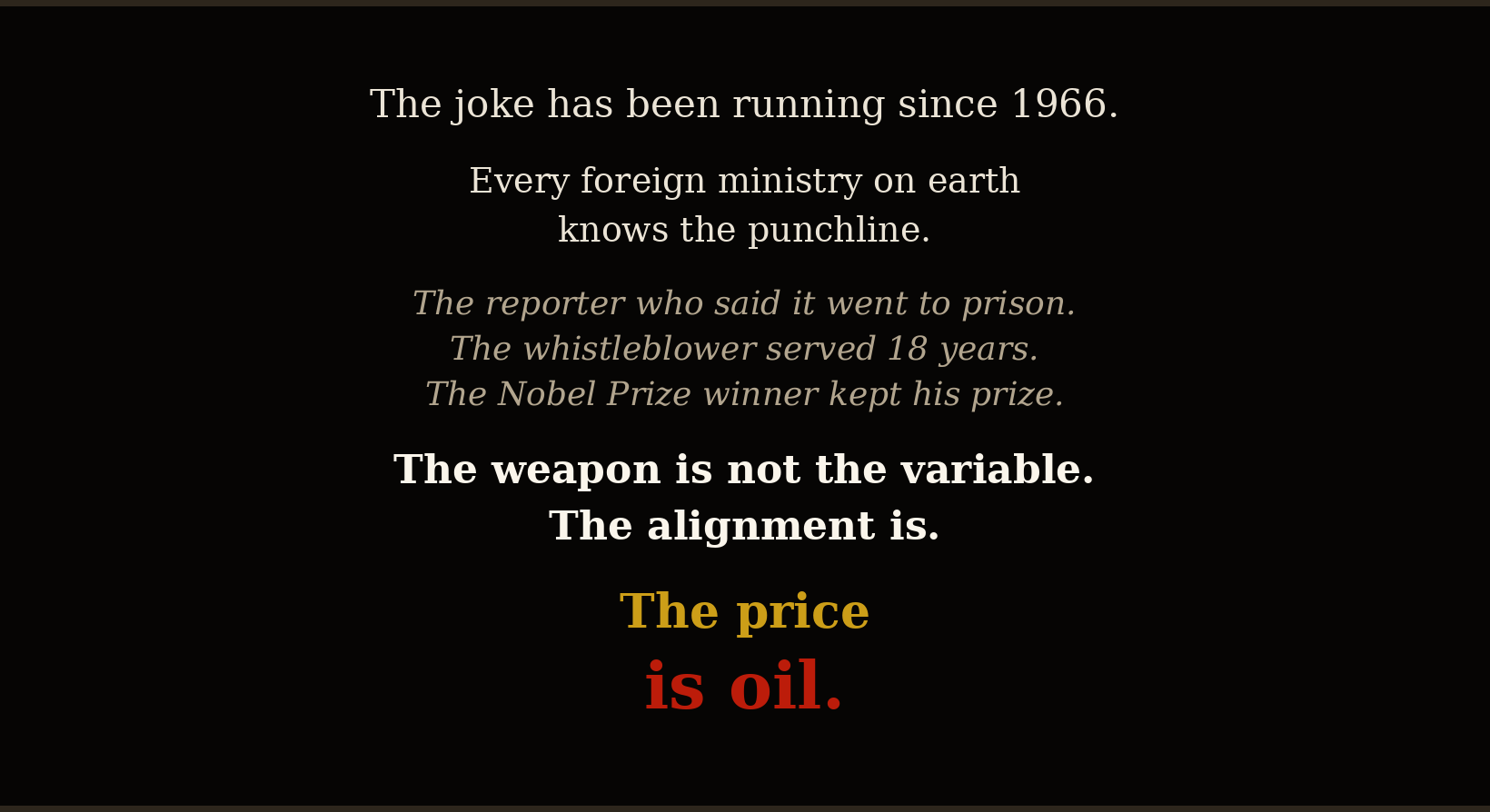
The treaty was written. The inspections regime was constructed. The norm was proclaimed. And the country that would become the most loudly committed defender of nonproliferation had already, before the ink dried, decided that the principle applied to everyone except the ally it had decided to protect. The joke has been running since 1966. The setup is sixty years long. Everyone in every foreign ministry on earth knows the punchline. And the performance continues because the performance serves the interests of everyone performing it.
Part One
The Pattern
Oppose Publicly · Accommodate Privately · Upgrade After the Fait Accompli
After the UK and Israel developed nuclear weapons, the United States transferred to them advanced nuclear technologies — including ballistic missile technology, multiple re-entry vehicle technology, nuclear submarine propulsion, and thermonuclear warhead technology. The imported American nuclear technologies helped the two junior nuclear allies upgrade their fledgling nuclear programs and strengthen their nuclear capabilities.8
Read that slowly. The United States opposed the UK and Israeli nuclear programs. They developed weapons anyway. The United States then transferred advanced technologies to upgrade those programs. The opposition provides deniability. The accommodation provides the alliance benefit. The upgrade provides the deterrence value. At no point does anyone have to admit what has happened.
In 1976, Japanese LDP politicians arguing internally against NPT ratification were making the case that the United States was “proliferating, for example, by supplying Israel with nuclear technology.” This was a classified diplomatic conversation. The same argument, made publicly, would have been a diplomatic crisis. Made in a classified internal deliberation, it was simply accurate.7
Japanese politicians in 1976 knew. They said so in a classified room. No one responded. The NPT continued. The proliferation continued. The deniability was maintained.
The US view of the nuclear reality in Israel, India, and Pakistan has been a situation to be “managed” rather than reversed. The basic determinant of American attitude toward the possession of nuclear weapons by other countries is whether the regime is supportive of or antagonistic to US interests.9 That sentence is from the Arms Control Association — not a polemical outlet but the primary professional organization for nonproliferation policy in the United States. It states plainly what the sixty-year record documents: the standard is not nonproliferation. The standard is alignment.
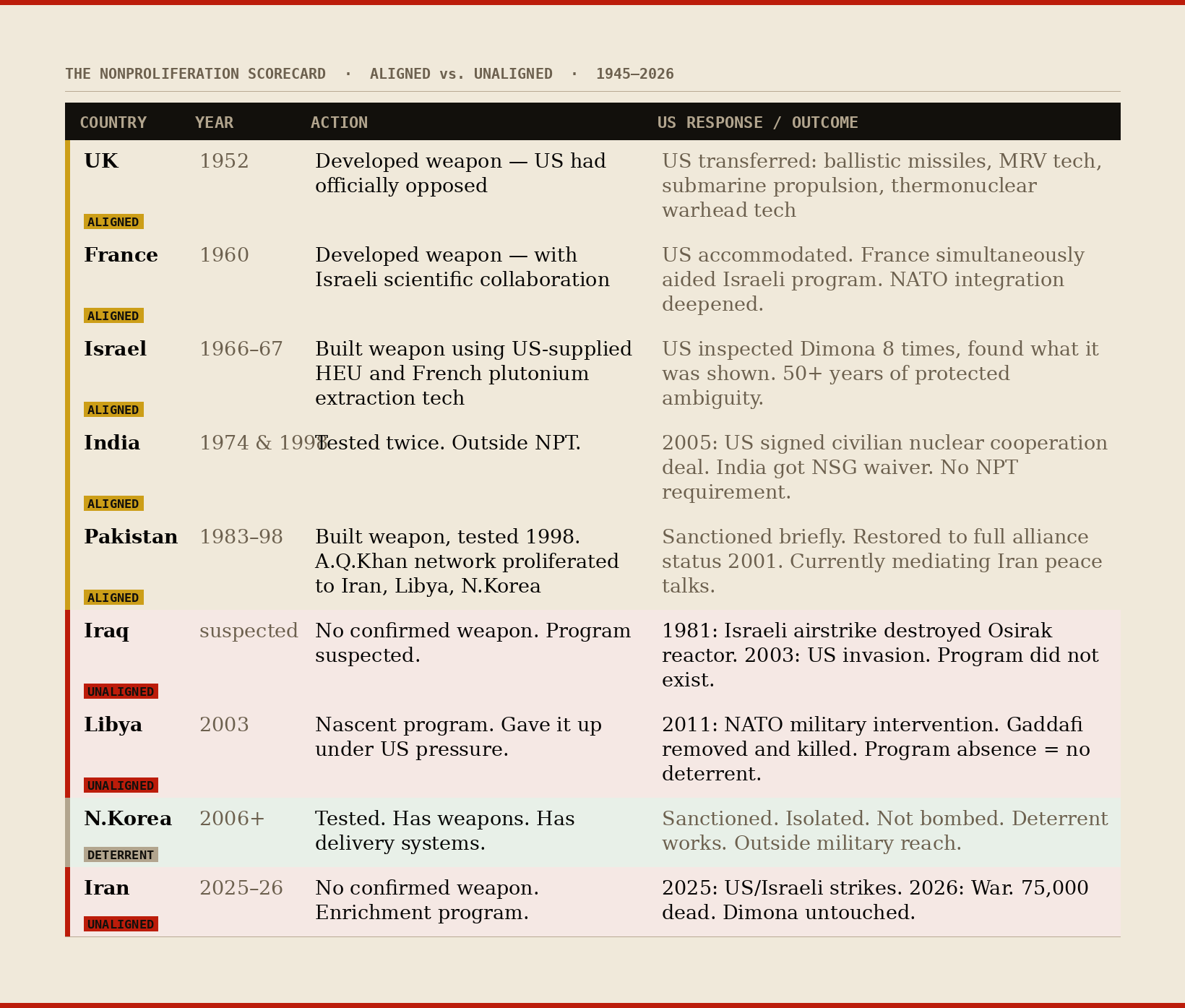
Sources: CFR · Oxford CJP · Arms Control Association · World Nuclear Association · SIPRI · 1945–2026
The pattern across both columns — aligned and unaligned — is identical on examination. Iraq, Syria, Libya, and Iran were not struck because they had weapons or were close to having them. They were struck because they were not aligned. Israel, Pakistan, India, and Saudi Arabia were not struck — were accommodated, managed, upgraded, or given favorable nuclear cooperation agreements — because they were aligned, or close enough to be useful.
The war to prevent Iranian proliferation was conducted by a country with 5,550 nuclear warheads, on behalf of a country with 90 to 400, against a country with zero confirmed weapons. Say that sentence until it lands.
Part Two
What Happens When You Say It
Mordechai Vanunu · Dimona · 1986 · 18 Years · Still in Israel
In 1986, Mordechai Vanunu, a technician who had worked at Dimona’s secret underground weapons facility for nine years, revealed the Israeli nuclear program to the Sunday Times with photographs taken inside the facility. Nuclear weapons expert Dr. Theodore Taylor assessed the evidence: “There should no longer be any doubt that Israel is and for at least a decade has been a fully fledged nuclear weapons state. The Israeli nuclear weapons program is considerably more advanced than indicated by any previous report or conjectures of which I am aware.”4
The Sunday Times published. Vanunu was lured to Rome by a Mossad agent. Sedated. Handcuffed. Smuggled to a ship off La Spezia. Transported to Israel by sea. Tried in a closed court. Sentenced to 18 years — eleven of them in solitary confinement. Released in 2004. Denied a passport. Still in Israel. Still cannot leave. Israel’s official position: it has no nuclear weapons.5
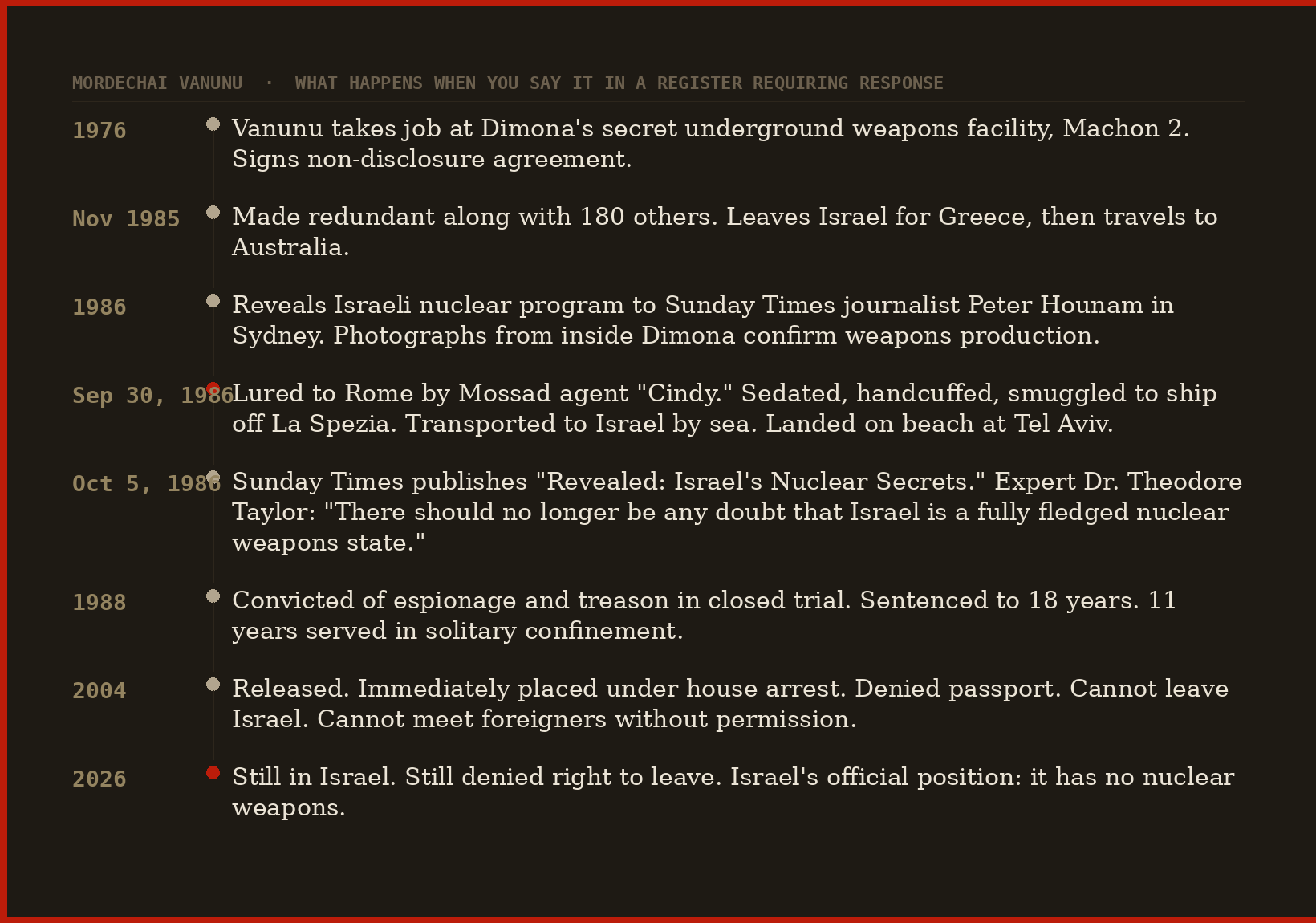
Sources: Wikipedia — Mordechai Vanunu · Sunday Times October 5, 1986 · Times of Israel · Israel Affairs journal
Had Vanunu been, say, an Iraqi or Iranian whistleblower with evidence of nuclear secrets in those countries, who had come to the Sunday Times, been abducted and tried for treason — it is hard to imagine the world’s leaders would have remained silent. They would have feted such a person as a hero. Yet here was a man who had been locked away for most of his adult life after being kidnapped — a blatant offence against international law as well as the domestic law of the UK and Italy. Neither the UK nor Italy did anything in response.4
The reporter who broke the Sato-Nixon nuclear agreement in Japan went to prison. Vanunu served 18 years, eleven in solitary. The Nobel Peace Prize winner who proclaimed the Three Non-Nuclear Principles while secretly violating them kept his prize. Nishiyama Takichi, the Mainichi journalist who uncovered the secret pact, was convicted of obtaining government secrets. The pattern of what happens to people who say the thing in a register requiring response is part of the argument — not a footnote to it.
Part Three
The Screwdriver States
Japan · Saudi Arabia · The Capability · The Inspection Gap · The Mutual Silence
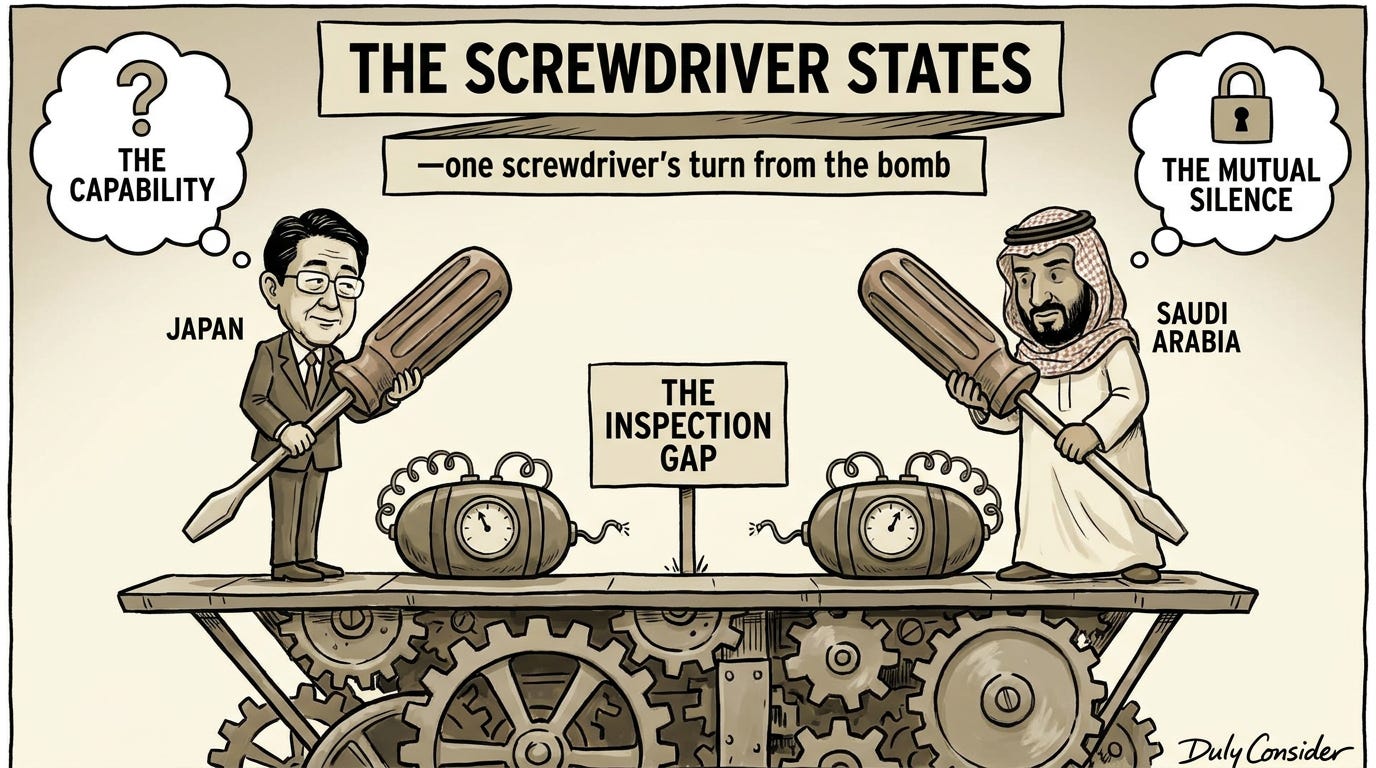
The term is from the nonproliferation literature, not from conspiracy writing. Japan is described as “one screwdriver’s turn from the bomb” — a technical description of a state that possesses sufficient fissile material, enrichment capability, weapons design knowledge, and delivery systems. Everything except final assembly.15, 16
Japan holds approximately 44.4 metric tonnes of separated plutonium — enough for an estimated 5,500 nuclear warheads by IAEA standards. Eight tonnes held domestically. A former director of Los Alamos National Laboratory assessed Japan could direct the assembly of a uranium weapon in six months to a year. Japan has ballistic missile technologies developed under its satellite launch programs and advanced fighter aircraft with nuclear delivery potential.15
In February 2022, Shinzo Abe — the longest-serving prime minister in Japanese history, great-nephew of the man who proclaimed the Three Non-Nuclear Principles while secretly violating them — said publicly on national television: “Japan should not treat as a taboo discussions on the reality of how the world is kept safe.” He called for NATO-style nuclear sharing. He added: “While Japan is not able to have offensive nuclear weapons, we are not saying that we will have no nuclear weapons at all.” He was killed four months later. The discussion did not happen. The infrastructure remains.20
You do not call for open discussion of a system that doesn’t exist. You call for open discussion of a system that exists and is not being discussed.
Saudi Arabia’s case is murkier because the opacity is deliberate. Under its current IAEA protocol, Saudi Arabia is not obligated to invite inspectors into its nuclear facilities. It constructed a yellowcake facility with Chinese assistance, denied its existence until satellite imagery confirmed it, and has signed a mutual defense pact with Pakistan explicitly described as covering “all military means.” Pakistan’s Defence Minister stated that nuclear capabilities could be extended to Saudi Arabia under the pact. The Trump administration’s November 2025 nuclear cooperation agreement with Saudi Arabia was specifically negotiated to avoid the Additional Protocol that would give inspectors access to undeclared facilities.22, 23, 12
The Saudi nuclear cooperation agreement was negotiated substantially by Jared Kushner’s network — the same Jared Kushner who receives $87 million in Saudi government fees through Affinity Partners. The man paid by the Saudi government helped negotiate an agreement that avoids the inspections that would confirm what is in Saudi facilities.
Part Four
The Pakistani Transaction
The Structural Conditions · The Prior Relationship · The Price
The transaction argument regarding Pakistan and Iran is not a hypothetical. It is a structural observation about conditions that exist simultaneously in ways they never have before. Pakistan has nuclear weapons. Pakistan is desperate for oil. Pakistan has stated the transaction framework publicly. Pakistan has a prior documented nuclear technology relationship with Iran. And Pakistan is currently the primary mediator of the peace negotiations between the United States and Iran in Islamabad — with access to both parties and no public transcript of what is discussed bilaterally.
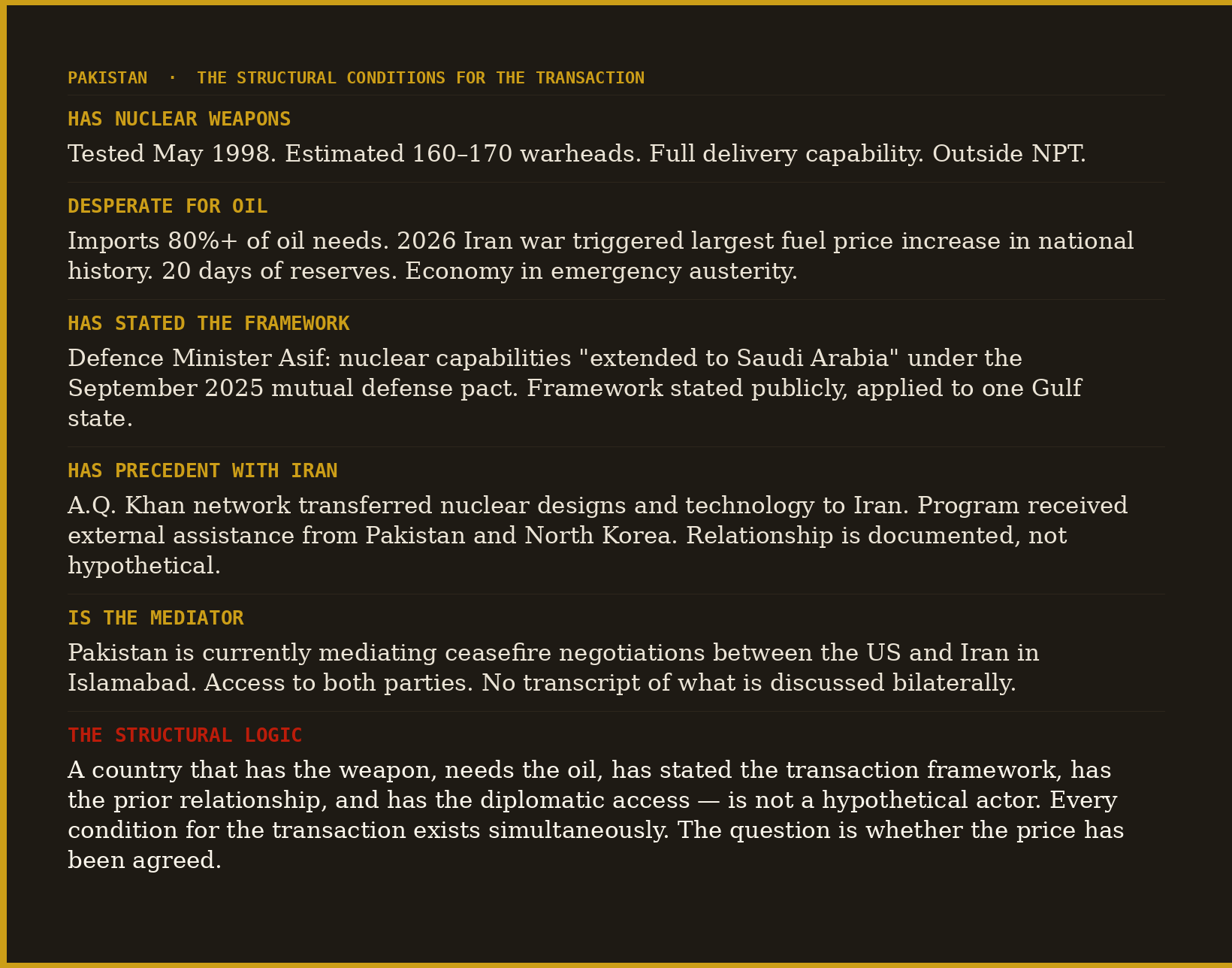
Sources: Al Jazeera March 2026 · Wikipedia Iran-US Negotiations 2025–2026 · CSIS Nuclear Network · CFR
The A.Q. Khan network transferred nuclear designs and technology to Iran. There is strong indication Khan did so with the knowledge of the Pakistani military — the same military the United States was simultaneously funding and equipping for the Afghan proxy war. The relationship between Pakistan and Iran on nuclear technology is not theoretical. It is documented. The transaction has already occurred in one direction.11, 14
Pakistan now has a Defence Minister who has stated publicly that nuclear capabilities can be extended to allies under formal defense arrangements. Pakistan’s economy is in emergency austerity from an oil shock caused by the war on Iran. Pakistan is the country sitting in the room with both sides. The skeptic observes that every structural condition for a transaction exists simultaneously in a way it never has before, and that the price of the thing Pakistan has and Iran wants is the thing Iran has and Pakistan desperately needs.
Part Five
The NPT as Performance
Managed Distribution · Not Quiet Success · 1945 to Now
The Harvard Belfer Center called the current nine-state nuclear world a “quiet success” of global nonproliferation efforts. The skeptic calls it a managed distribution. The difference between those two descriptions is the most important analytical distinction in nuclear policy.21
A quiet success implies the number nine was achieved through the diligent application of a principle. A managed distribution implies the number nine reflects decisions made by the states that already had weapons about which other states were allowed to join them — on the basis of alignment, not principle, enforced selectively, with convenient deniability at every step.
The documented record supports the second description. The United States supplied highly enriched uranium to Israel before the NPT existed. It transferred advanced technology to Israel and the UK after they developed weapons the US had officially opposed. It looked away from Pakistan’s program while Pakistan was strategically useful. It gave India a civilian nuclear deal without requiring NPT signature. It signed a nuclear cooperation agreement with Saudi Arabia specifically designed to avoid the inspection requirements it had always insisted upon. It is currently negotiating the terms of a peace agreement with Iran — bombed to prevent nuclear capability — through Pakistan, whose Defence Minister has offered to extend its nuclear capabilities to Gulf allies in exchange for strategic alignment.
Every step is deniable. Every step is documented. The deniability and the documentation coexist because deniability is the operational requirement and documentation is the historical residue, visible only when the archive declassifies what the current official position denies.
The joke has been on us since 1966. Not because the deception was clever. Because it was obvious. Because every Japanese LDP politician in 1976 knew the Americans were supplying Israel with nuclear technology. Because every foreign ministry in the world knows what is in Dimona and what the Pakistani-Saudi mutual defense pact actually covers. Because the NPT inspection regime has been applied with surgical precision to the states whose alignment made their weapons programs inconvenient, and carefully not applied to the states whose alignment made their weapons programs useful.
The tragedy is not that the joke exists. The tragedy is that it costs real people real things. The Iraqi civilian in 2003. The Iranian civilian in 2026. The 75,000 dead from a war to stop proliferation launched by a state with 5,550 warheads on behalf of a state with 90 to 400 that officially has none. All of them are inside the acceptable loss framework of a system that decided, before they were born, whose weapons matter and whose don’t.
The joke has been on them most of all.
References & Sources
1
SIPRI Yearbook 2025 Israel nuclear forces — stockpile estimated at 90 warheads, nuclear triad confirmed
2
Wikipedia — Israel and Nuclear Weapons (updated April 2026) 90–400 warhead estimates; first weapon completed late 1966/early 1967; Dolphin submarine second-strike capability
3
Mondoweiss (April 5, 2026) A brief history of the Israeli nuclear program, the open secret at the heart of the Iran war
4
Peter Hounam / Sunday Times (October 5, 1986) Revealed: The Secrets of Israel’s Nuclear Arsenal — Vanunu photographs, Dr. Theodore Taylor assessment
5
Wikipedia — Mordechai Vanunu Full record: Dimona employment 1976–85, 1986 disclosure, kidnapping in Rome, 18-year sentence, ongoing restrictions
6
Congressman Joaquin Castro et al., letter to Secretary Rubio (May 4, 2026) Policy of official ambiguity makes coherent nonproliferation policy in the Middle East impossible; 1974 SNIE concluded Israel possessed nuclear weapons
7
National Security Archive / George Washington University (June 25, 2025) History of US Nuclear Nonproliferation Policy 1969–1977 — Japanese LDP politicians arguing US was “proliferating by supplying Israel with nuclear technology”
8
Oxford Academic / Chinese Journal of International Politics (June 2023) Upgrading the Bomb: How the US Provides Advanced Nuclear Assistance to Junior Allies — UK, France, Israel documented
9
Arms Control Association (December 2003) Israel, India, and Pakistan — the US view of nuclear reality as a situation to be “managed” rather than reversed
10
World Nuclear Association — Nuclear Proliferation Case Studies Israel: US supplied 5MWt reactor and HEU 1955; French plutonium extraction technology; Israeli scientists at Marcoule
11
Council on Foreign Relations — The Four Nuclear Outlier States A.Q. Khan network: shared designs with Libya, Iran, North Korea; strong indication Pakistani military knew
12
CSIS Nuclear Network (December 2025) All Military Means? Pakistan, Saudi Arabia, and the Risks of Nuclear Ambiguity — September 2025 mutual defense pact analysis
13
Al Jazeera (March 10, 2026) Pakistan orders sweeping austerity measures as Iran war triggers oil crisis — 80%+ import dependence, largest fuel price increase in history
14
Wikipedia — 2025–2026 Iran–United States negotiations Iran nuclear program received external assistance from Pakistan and North Korea; Pakistan mediating Islamabad talks
15
Korea Economic Institute of America (March 13, 2026) How the War in Iran Reshapes South Korea and Japan’s Nuclear Strategy — Japan 45 tonnes weapons-grade plutonium; 6 months to first weapon
16
Wikipedia — Japanese Nuclear Weapons Program Japan “one screwdriver’s turn” from the bomb; 44.4 tonnes separated plutonium; de facto nuclear state
17
Nautilus Institute for Security and Sustainability Japan Under the US Nuclear Umbrella — declassified documents: Japanese government “tacitly permitted” nuclear weapons in harbors
18
Asia-Pacific Journal: Japan Focus Six Decades of US-Japanese Government Collusion in Bringing Nuclear Weapons to Japan — Sato-Nixon 1969 secret agreement
19
Carnegie Endowment for International Peace (March 2026) Revisiting Japan’s Non-Nuclear Principles — satellite imagery era and the pressure to update the non-introduction principle
20
Bulletin of the Atomic Scientists (August 2022) The legacy of Shinzo Abe: Japan divided about nuclear weapons — “while not able to have offensive nuclear weapons, we are not saying we will have no nuclear weapons at all”
21
Harvard Gazette / Belfer Center (April 2026) Deterring the next nuclear arms race — nine nuclear states described as “quiet success”; post-Cold War regime beginning to break down
22
Arms Control Association — Israel May Be Building Uranium Facility Saudi Arabia not obligated to invite IAEA inspectors; yellowcake facility denied then confirmed by satellite
23
Arms Control Association (February 2026) Is Trump Jeopardizing Nonproliferation Efforts to Get a Nuclear Deal with Saudi Arabia — 123 agreement falls short of nonproliferation provisions
24
Duly Consider — Bryan E. Hall The Sentinel Compact: Who Stops the Stoppers?
Duly Consider covers politics, science, technology, and philosophy without apology.
© 2026 Bryan E. Hall · bryanehall.substack.com