
The Three Thresholds, UN Does NOT Suffice
A Draft Architecture for What Comes After the Abused UN Vetos

DULY CONSIDER · POLITICS · SCIENCE · TECH · PHILOSOPHY
GEOPOLITICS SERIES · THE INSTITUTIONAL ARCHITECTURE INTERNATIONAL ORDER · THE VETO · WHAT COMES AFTER
The United Nations Charter does not contain the word “veto.” Read the document. Search it. The word is not there. Article 27(3) requires that Security Council decisions on non-procedural matters be made by “an affirmative vote of nine members including the concurring votes of the permanent members.” The veto is the colloquial name for what happens when a permanent member withholds concurrence. The most consequential power in the postwar international order was not granted. It was embedded in a voting procedure and never named.
This is not a technicality. It is the founding architecture of a system designed to be unreformable by those it fails. The lock is self-sealing: Article 108 requires Charter amendments to be ratified by two-thirds of all member states including all five permanent members. Any P5 member can veto any amendment. The veto protects itself. The word that doesn’t appear in the document protects the power it doesn’t name.
This piece proposes the architecture of what must replace it. Not a reformed UN. Not a renamed UN. A new body, founded on different principles, built without the founding sin of 1945 — and consistent, at every pillar, with the Sentinel Compact.
PART ONE
The Documented Failure
What 80 years of the veto actually produced
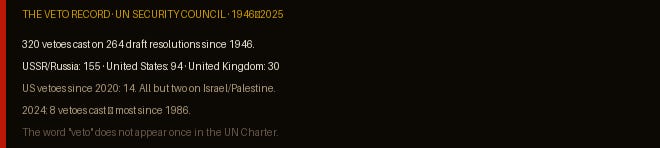
THE VETO RECORD · UN SECURITY COUNCIL · 1946–2025 · SOURCE: SECURITY COUNCIL REPORT, MARCH 2026
Since 1946, the veto has been used 320 times on 264 draft resolutions.1 The Soviet Union and Russia account for 155 of those — the bulk in the early decades blocking membership applications, the recent ones covering Syria and Ukraine. The United States has cast 94, more than any other permanent member since 1970, most frequently to block action it regards as detrimental to Israel.2
The numbers from the past decade are the document. In 2024, eight vetoes were cast on seven failed resolutions — the most since 1986.1 Four by Russia. Three by the United States. One by China. In 2025, four more: two by the US on Gaza, two by Russia on Ukraine.1 The US has cast 14 vetoes since 2020. All but two were on Israel and Palestine.2
A ceasefire resolution on Gaza drew 13 votes in favor, including three permanent members — China, France, and Russia. The United States vetoed it alone.3 The resolution had been co-sponsored by nearly 100 member states within 24 hours of circulation. One permanent member, acting in its own interest, silenced the expressed will of the overwhelming majority of the international community.
The Security Council is not a governance structure. It is a managed forum for the permanent five to conduct disagreements without shooting at each other directly — with rules that apply fully to everyone below them and partially to no one above.
The veto also operates before the vote. It is not unusual for a draft resolution not to be formally tabled because the threat of a veto by one or more permanent members renders the exercise futile.1 The chilling effect is undocumented precisely because it leaves no paper trail. Every resolution that was never written because someone knew it would be vetoed is a failure the ledger cannot capture. Myanmar. Ethiopia. The Rohingya. The full accounting is larger than the 320 recorded uses suggest.
PART TWO
The Same Architecture, Different Names
How every major multilateral body converges on the same solution
The UN’s veto is not unique. It is the visible instance of a universal principle: powerful states will not join a body that can bind them against their will. The mechanism varies. The outcome doesn’t.
The SCO — the Shanghai Cooperation Organisation, which includes China, Russia, India, Pakistan, Iran, and several Central Asian states — operates by consensus. Every member must agree for a decision to pass. Any single member can block any collective action by withholding agreement. It is not called a veto. It is called consensus. The functional outcome is identical.
NATO requires unanimity for Article 5 invocation and for membership decisions. Hungary used it to delay Sweden’s accession for nearly two years. The EU requires unanimity on foreign policy and taxation — the domains where sovereignty feels most at stake. ASEAN operates by consensus. Every major multilateral body that includes powerful states converges on the same procedural escape hatch: no powerful state can be outvoted on anything it considers existential.
The architecture is the admission. These are not governance structures. They are coordination structures for states that remain sovereign and intend to stay that way. The question is not how to reform this architecture inside existing institutions. Those institutions were designed to resist reform by the people they fail. The question is how to build something new — outside, alongside, accumulating legitimacy through use — that these institutions cannot veto into silence.
PART THREE
The ICC Proof of Concept
What was built without great power permission — and what it proved

THE ICC PROOF OF CONCEPT · ROME, 1998 · THE WARRANT IS THE ARGUMENT
In July 1998, 120 nations voted to adopt the Rome Statute founding the International Criminal Court. Seven voted against. The United States, China, and Israel were among them — confirmed publicly.4 Russia eventually signed and then withdrew without ratifying. The court was founded over the explicit objection of the three largest military powers on earth.
The US did not merely abstain. The George W. Bush administration “unsigned” the Rome Statute in 2002 and passed the American Service-Members’ Protection Act, authorizing measures against the court.5 The Trump administration sanctioned ICC officials in 2020.5 After the Netanyahu warrant in November 2024, Congress passed legislation imposing further sanctions on ICC personnel.5 The most powerful state in the world has spent twenty-six years trying to suppress a court it could not veto into nonexistence — because the court was founded without asking its permission.
And the court issued the Putin arrest warrant anyway. And the Netanyahu warrant. Neither man can travel freely to the 124 member states that recognize the court’s jurisdiction.4 The enforcement has not followed. The record has. The warrant exists. It cannot be vetoed retroactively. It changes the political cost of every allied relationship, every arms sale, every state visit involving those individuals — permanently, without a single soldier deployed.
The ICC did not defeat great power impunity. It changed its cost. That is the proof of concept. Build the body without their permission. Issue the finding. The record is the enforcement.
The lesson is precise: you do not need the great powers to found the body. You need them to be unable to erase what the body produces. The ICC’s founding error was jurisdictional narrowness — war crimes and genocide only, no economic crimes, no systematic dispossession, no climate accountability. The architecture of what comes next must be broader. But the founding method is established. Majority of nations. No permanent veto class. Build it. Issue the findings. Let the record accumulate.
PART FOUR
The Three Thresholds
A draft architecture for what the new body actually does
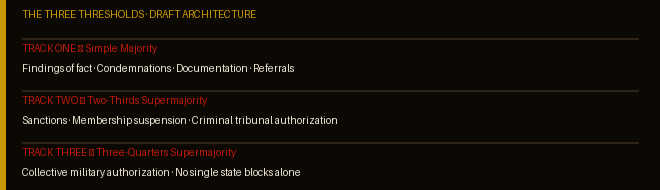
THE THREE THRESHOLDS · DRAFT ARCHITECTURE · MAY 2026
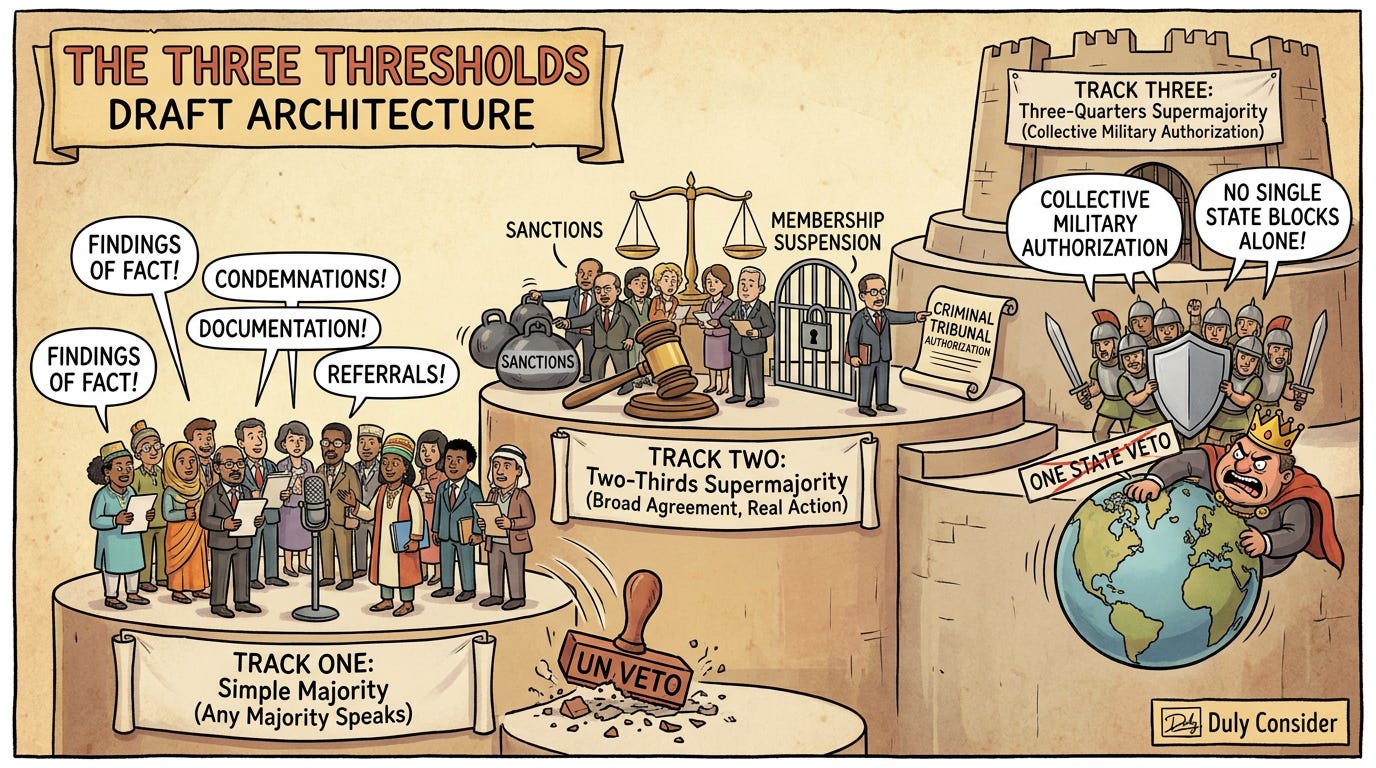
The UN’s founding failure was structural: it bundled documentation, condemnation, sanctions, and military authorization into a single chamber operating under a single voting rule. A finding that Russian troops are in Ukraine requires the same threshold as authorizing military response to Russian troops in Ukraine — and Russia sits in both votes. The architecture is not broken. It was built this way deliberately. The question is what architecture replaces it.
The framework maps onto the legal standard of proof that already governs how we calibrate consequence to certainty. More serious action requires higher threshold. The response matches the burden. This is not a novel principle. It is the operating logic of every functioning legal system. It has never been applied to international collective action.
Track One — Simple Majority: Findings of fact, condemnations, documentation, referrals to criminal bodies. Any majority can speak. The record exists. No single state silences it. A majority finding that a ceasefire is required, that a civilian population is being starved, that a territorial invasion violates international law — these require only that most of the world’s nations agree. The powerful state can ignore the consequence. It cannot erase the document. The UN General Assembly already operates roughly on this principle — the difference is that the new body’s findings carry the legal standing of a founding charter, not merely the moral weight of a non-binding resolution.
Track Two — Two-Thirds Supermajority: Economic sanctions, membership suspension, referral to criminal tribunals, trade consequences. Meaningful action requires broad agreement — not unanimity, but genuine coalition weight. Two-thirds of member nations represents a political majority that no single great power can dismiss as a regional bloc or an aligned faction. It requires the aggrieved to have assembled real international consensus. The sanction carries the authority of that consensus.
Track Three — Three-Quarters Supermajority: Collective military authorization. The hardest threshold. Never unanimous — a blocking minority exists — but no single state holds a veto alone. To block collective military response to naked aggression, a state would need to assemble 25% of the membership in opposition. That is achievable for contested conflicts where the aggressor has genuine allies. It is not achievable for the unambiguous cases — the Rwanda that the UN watched, the Srebrenica the UN failed, the Gaza the Security Council could not speak to — where the obstruction was a single permanent member acting alone.
PART FIVE
No Permanent Classes
Correcting the founding sin of 1945

THE FOUNDING SIN — AND ITS CORRECTION
The United Nations made one decision in 1945 that determined everything that followed: it awarded permanent Security Council seats and veto power to the victorious military powers of that specific moment. The United States, the Soviet Union, the United Kingdom, France, and the Republic of China — the holders of 1945 military power — were given permanent institutional weight that has never been subject to revision.
France has not been a great military power by any objective measure since 1940. The Republic of China lost the Chinese Civil War and retreated to Taiwan before the UN was fully operational — the People’s Republic of China didn’t take the seat until 1971. The United Kingdom’s empire ceased to exist within two decades of the founding. The Soviet Union dissolved in 1991. The permanent five of 2026 are the permanent five of 1945 by institutional inertia, not by any principled account of who holds consequential power in the world today.
The new body corrects this by founding principle: no permanent classes. No seat that carries different weight by virtue of who holds it. Brazil’s vote counts equal to France’s. India’s vote counts equal to the United States’. Nigeria’s vote counts equal to Russia’s. Indonesia — the world’s fourth most populous nation, the largest Muslim-majority democracy, an economy larger than the Netherlands — votes equal to the United Kingdom.
This is not utopianism. It is the operating principle of every functioning democratic legislature in the world. The United States Senate gives Wyoming the same two votes as California — a different distortion, but the same founding principle that equal units of political organization receive equal institutional representation. The new body applies that principle to nations.
PART SIX
How You Build It
The founding method that the great powers cannot veto
The moment you invite a great power to the founding table, they will demand their escape hatch as the price of participation. This has happened every time. It happened at the UN in 1945. It happened at the SCO. It happened at NATO. The consensus requirement is always the condition of great power membership. So the answer is: do not invite them to the founding.
Start with the middle powers. India, Brazil, Turkey, South Africa, Indonesia, Nigeria, Mexico, Saudi Arabia, Argentina, Egypt, Bangladesh, Pakistan, Ethiopia, the Philippines, Vietnam — nations that collectively represent the majority of the world’s population, the majority of the world’s GDP outside the G7, and the totality of the Global South’s political energy. Found the body among themselves. Write the charter on majority and supermajority voting with no permanent class. Issue the first findings. Build the precedent.
Then invite the great powers to join — on the terms already written, not to be negotiated. Take it or leave it. Their absence is itself the document: a finding that the powerful prefer a system they can veto to a system that operates by majority. Let that finding accumulate in the record of the new body’s proceedings.
India is the hinge. India has maintained strategic non-alignment for seventy years because the uncommitted position carries leverage. India inside this founding coalition changes the geometry of everything. It makes the body unignorable. It makes the US and China’s absence from the founding look like what it is — a preference for impunity over accountability. Getting India to commit is the hardest diplomatic problem of the next twenty years. It is also the most important.
You do not defeat the veto. You make it irrelevant by building the room it cannot reach. The Security Council retains its authority over the states that recognize it. The new body accumulates authority over everyone else. Over time, the room nobody important goes to anymore is the one with the veto.
PART SEVEN
The Sentinel Compact at Scale
The same four pillars — applied to the architecture of states themselves
The Sentinel Compact identifies four pillars as the foundation of accountable governance: transparency, accountability, proportionality, and distributed power. Every piece in this series has diagnosed a failure against one or more of those pillars. The Three Thresholds is the Compact applied not to institutions within states but to the architecture of states themselves — the international order that governs what states can do to each other and to the people inside them.
Transparency is Track One. The majority finding is the transparency mechanism. What the UN cannot document because the US vetoes the resolution — this body documents by simple majority. The Putin warrant is transparency operating without great power permission. The new body systematizes that mechanism. The record exists. The powerful state can ignore the consequence. It cannot erase the document.
Accountability is Track Two. Documentation without consequence is not accountability — it is witness. The two-thirds threshold for sanctions and criminal referrals converts the record into consequence. It requires the aggrieved to have assembled genuine coalition weight, which means the accountability carries political authority proportionate to its breadth.
Proportionality is the three-threshold architecture itself. The UN’s fatal flaw is that a ceasefire demand and a military authorization require identical thresholds — which means both are subject to the same single-state veto. Your framework separates them. The response matches the burden. The finding requires less than the sanction. The sanction requires less than the war. This is proportionality as institutional design.
Distributed power is no permanent classes. The founding sin of 1945 was the permanent concentration of institutional power in five states defined by a single historical moment. The new body distributes that power across its membership — equal votes, majority decisions, no inherited veto. Power is not eliminated. It is distributed, as the Compact requires, so that no single actor can capture the system and run it for their own account.
The Sentinel Compact is the argument applied to individuals and institutions within existing states. The Three Thresholds is the argument applied to the architecture of states themselves. The pillars are the same. The scale is different.
Build it before you need it. The Rwanda that waited for the Security Council to act lost 800,000 people in 100 days while the permanent members managed their consensus. The next one is already somewhere on the ledger — undocumented, uncharged, unresponded to, because the room with the veto could not speak.
The Three Thresholds is what speaking looks like when the veto cannot reach it.
THE SENTINEL COMPACT — THE PRESCRIPTIVE ANCHOR
Every piece in the Duly Consider series that diagnoses a failure points toward the Sentinel Compact as the constructive answer. The Four Pillars — transparency, accountability, proportionality, distributed power — are the architecture of every functioning accountable system, at every scale.
The Three Thresholds is the Compact applied to international order. The diagnosis is 80 years of veto. The prescription is the room the veto cannot reach.
REFERENCES
1
SECURITY COUNCIL REPORT (MARCH 2026) Veto Report 2026 — 320 vetoes on 264 draft resolutions since 1946; 2024 had most vetoes since 1986; chilling effect on resolutions never tabled; Article 27(3) obligatory abstention clause dormancy
2
SECURITY COUNCIL REPORT / GLOBAL AFFAIRS COUNCIL (2024–2026) The Veto — US cast 94 vetoes total, more than any P5 member since 1970; 14 vetoes since 2020, all but two on Israel/Palestine; US used veto 21 times for Israel between 1982–1990 alone
3
UN PRESS RELEASE (DECEMBER 8, 2023) Security Council fails to adopt Gaza ceasefire resolution — 13 in favor including China, France, Russia; US sole veto; resolution co-sponsored by 97 member states within 24 hours
4
COUNCIL ON FOREIGN RELATIONS / WIKIPEDIA (1998–2026) Role of the ICC — Rome Statute adopted 120-7 in 1998; US, China, Israel confirmed as opposing votes; 124 member states today; Putin warrant March 2022; Netanyahu warrant November 2024
5
WIKIPEDIA / HUMAN RIGHTS WATCH (2002–2026) United States and the ICC — Bush “unsigned” 2002; American Service-Members’ Protection Act; Trump 2020 sanctioned ICC officials; Congress Jan 2025 sanctions on ICC personnel following Netanyahu warrant
6
OXFAM INTERNATIONAL (SEPTEMBER 2024) UN Security Council casts nearly all vetoes last decade on Syria, Palestine, Ukraine — 27 of 30 vetoes on these three conflicts; US vetoed 6 resolutions on Palestinian human rights; pen-holding power compounds veto effect
7
DULY CONSIDER — BRYAN E. HALL The Sentinel Compact — the four pillars of accountable governance: transparency, accountability, proportionality, distributed power. The constructive anchor of this series.
8
DULY CONSIDER — BRYAN E. HALL Silk Road: Adults in the Room — Xi briefing Trump; Iran-China deal; the parallel architecture already being built outside Western institutions