
The War Nobody Will Name
On the $400 billion contract that reframes everything — and the three countries whose economic interests were struck without their consent, without their knowledge, without a single headline saying so

Read their contract before you read the argument.
On March 27, 2021, China and Iran signed a 25-year Comprehensive Strategic Partnership agreement. The terms, leaked in an 18-page draft confirmed by the New York Times and the Wall Street Journal, are precise: China commits up to $400 billion in investment — $280 billion into Iran’s oil, gas, and petrochemical sectors; $120 billion into transportation and manufacturing infrastructure — in exchange for a steady, heavily discounted supply of Iranian crude. Military and security cooperation is explicitly included. Intelligence sharing. Joint exercises. Technology transfers that US officials documented as including missile propulsion and guidance system components. The deal entered its implementation stage in January 2022.1, 2, 3
By February 28, 2026, the United States and Israel attacked the counterparty to that contract.
Say that sentence again with the contract in mind.
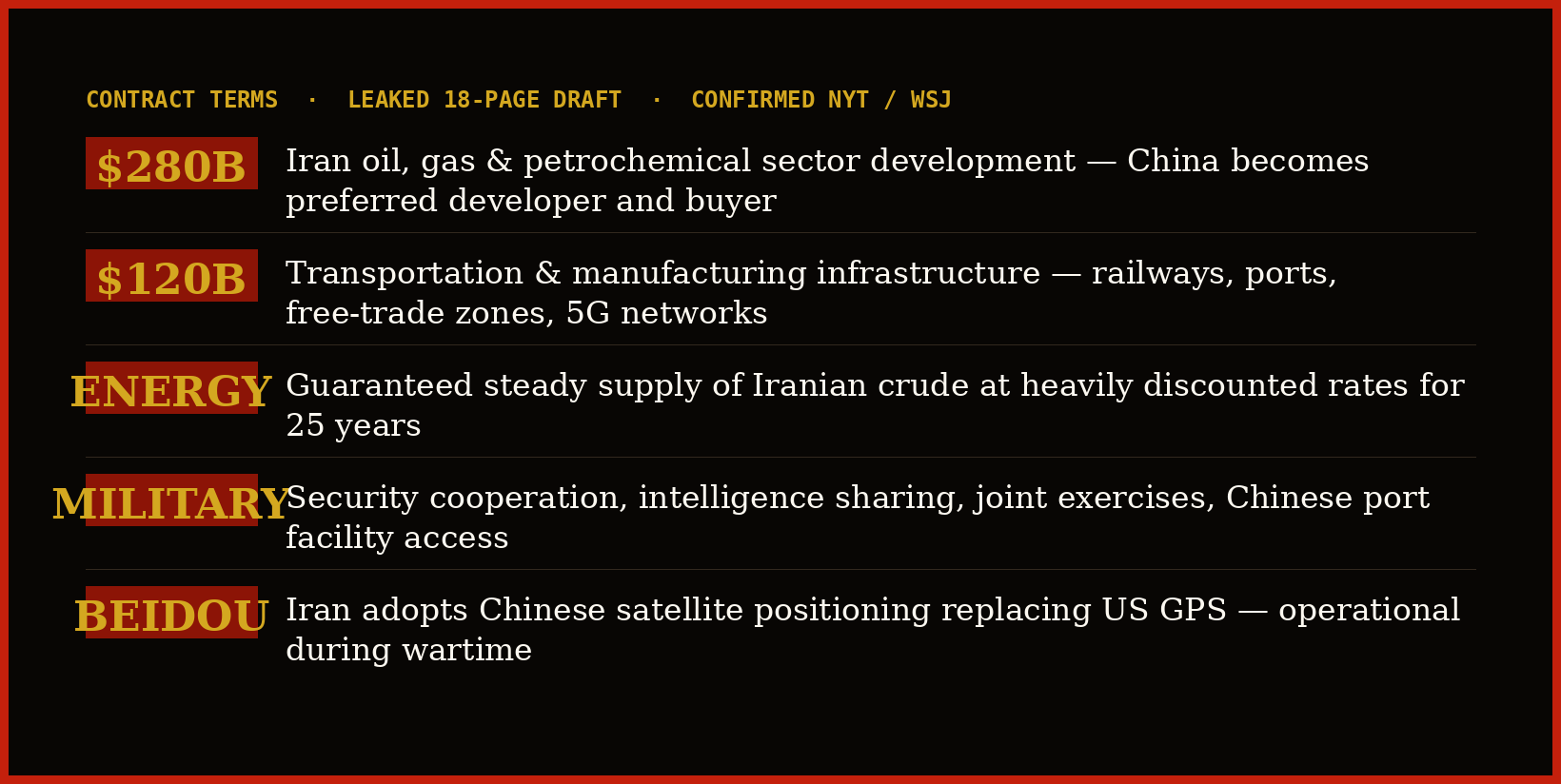
Source: 18-page leaked draft · New York Times · Wall Street Journal · Petroleum Economist · March 2021
What the Contract Means
Vertically Integrated Energy Security · Shadow Fleet · Missile Components · $31.2B Unreported Trade
The 2021 agreement is not a diplomatic pleasantry. It is a structured economic instrument. China was purchasing, at a 25-year guaranteed discount, the oil supply that its manufacturing economy requires. Iran was purchasing, through Chinese investment and security cooperation, the infrastructure and military capacity that sanctions had denied it. Both parties were purchasing insurance against US-enforced exclusion from the dollar system.4
Chinese purchases account for roughly 90 percent of Iran’s exported oil, providing tens of billions of dollars in annual revenue that supports Iran’s government budget and military activities. By 2025, China reported $9.96 billion in total bilateral trade with Iran — not including roughly $31.2 billion in unreported Iranian crude oil exports, which if included comprise over 75 percent of total bilateral trade.4
China built the shadow fleet that moves Iranian oil. Chinese banks and front companies facilitate the transactions. Chinese technology underpins Iran’s communications infrastructure. Beijing has sold air defense systems, anti-ship missiles, ballistic missile components, and dual-use items including precursors to support Iran’s missile propulsion and guidance systems.6
This is not a trading relationship. It is a vertically integrated energy security architecture. And on February 28, 2026, the United States and Israel bombed it.

The Three Countries Nobody Mentions
China · India · Pakistan · None Consulted · All Absorbing the Consequences
The Western framing of this war has a cast of two: the United States and Iran. That framing is operationally false.
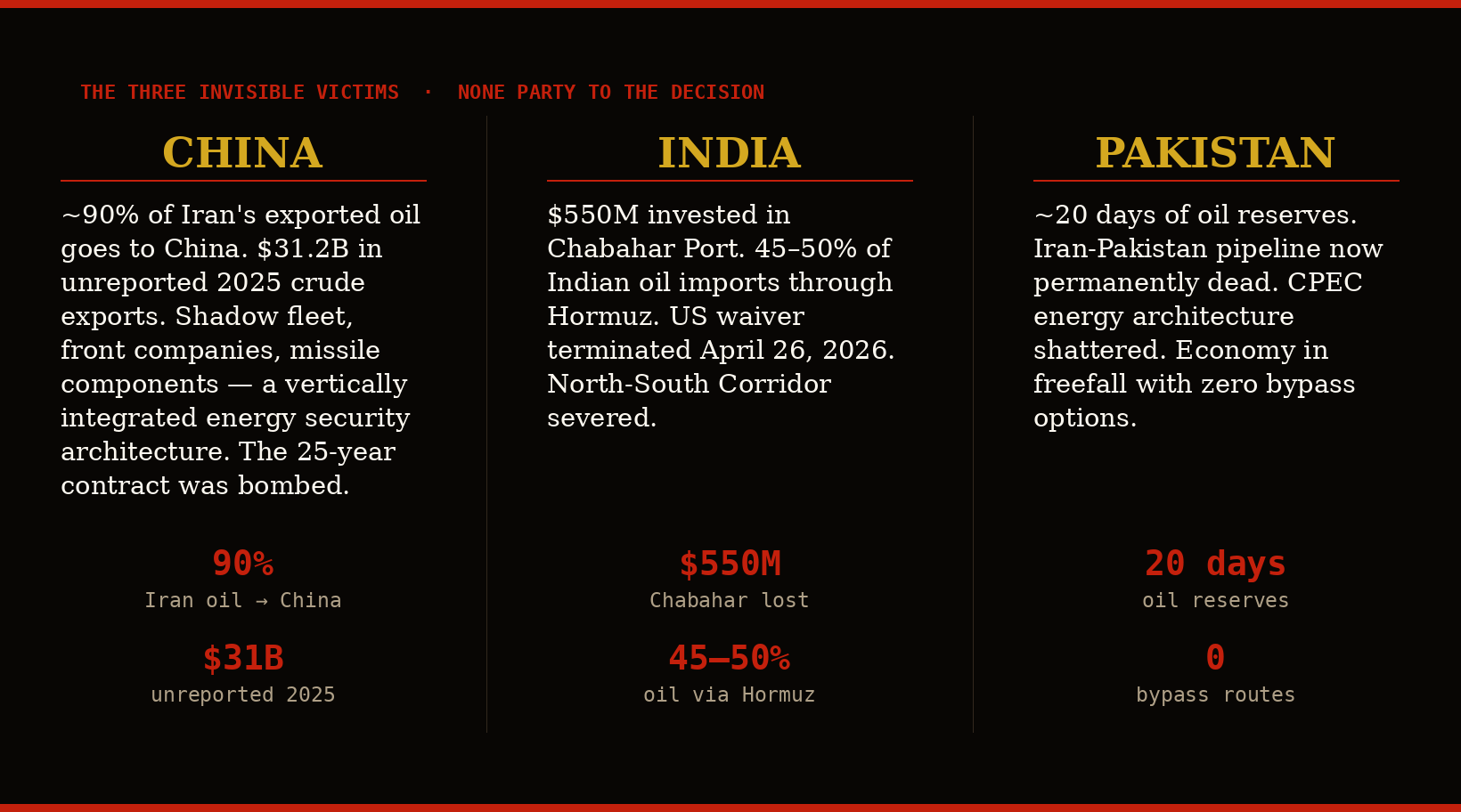
Sources: USCC 2026 · CNBC 2026 · The Quint 2026 · TIME 2026 · The Global Economics 2026
China is the primary economic victim of the war’s design — whether or not it was the intended target. Around 80% of Asia’s oil imports pass through the Strait of Hormuz, which has been effectively closed since February 28.7 China’s guaranteed discounted oil supply — contracted for 25 years — now transits a strait that charges yuan-denominated tolls when it moves at all, at $119 a barrel instead of the contracted discount. The $400 billion infrastructure investment China committed to Iran is now a war zone. The Chinese population in Iran — evacuated en masse in March — is gone. Bilateral trade decreased by 25 percent last year. In practice, China had invested only about $9 billion in Iran over the last ten years and nothing since 2018. The contract existed largely on paper. The war made certain it stays there.5
India is the second invisible casualty. Nearly 45–50% of India’s oil imports pass through the Strait of Hormuz.9 India had invested $550 million in Iran’s Chabahar Port — a strategic gateway to Central Asia that bypasses Pakistan — under a 10-year operational contract secured in 2024. India lost its conditional sanctions waiver to Chabahar on April 26, 2026. The International North-South Transport Corridor — India’s overland route to Russia and Europe through Iran — is severed. Modi visited Israel the day before the attack. India was notably silent when a US submarine sank an Iranian warship returning from exercises hosted by India.8
Pakistan is the third. Pakistan maintains roughly 20 days of oil reserves.7 The Iran-Pakistan gas pipeline — blocked for decades by US sanctions — is now a fantasy for a generation. The China-Pakistan Economic Corridor runs through territory whose regional energy architecture has just been shattered. Pakistan’s economy, already on the edge, is absorbing an oil shock it has no buffer for.10
Three nuclear-armed or nuclear-capable states. Three economies structurally dependent on the strait that was closed. Three governments with deep, documented, contractual interests in the country that was attacked. None of them party to the decision. None of them consulted. All of them absorbing the consequences.
The Question Nobody Is Asking
The Reframe · Economic War · Standing · The Only Reason We Don’t Say It
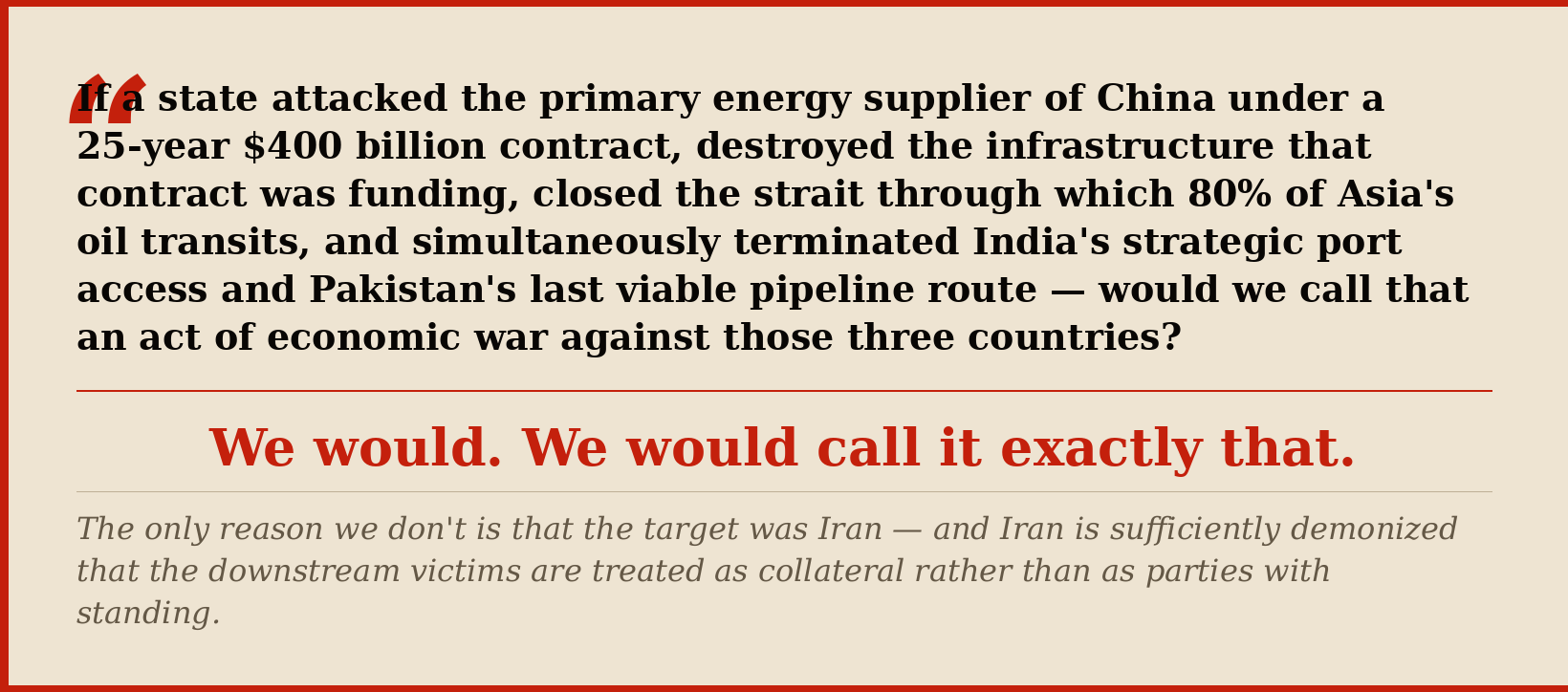
China values its relationship with Iran for three primary reasons: Iranian oil supports China’s energy security; Iran’s adversarial relationship with the United States diverts American attention and resources that could otherwise be trained on countering China; and Iran serves as an entry point for China to assert greater influence in Southwest Asia.6 All three of those functions have now been degraded or destroyed simultaneously by a single military action. That is either an extraordinary coincidence, or it is strategy. The United States government has not been asked, in any major press venue, to clarify which it is.
Why Nobody Says It
The Structural Silence · Four Acknowledgments That Collapse the Frame
The silence is not accidental. It is structural.
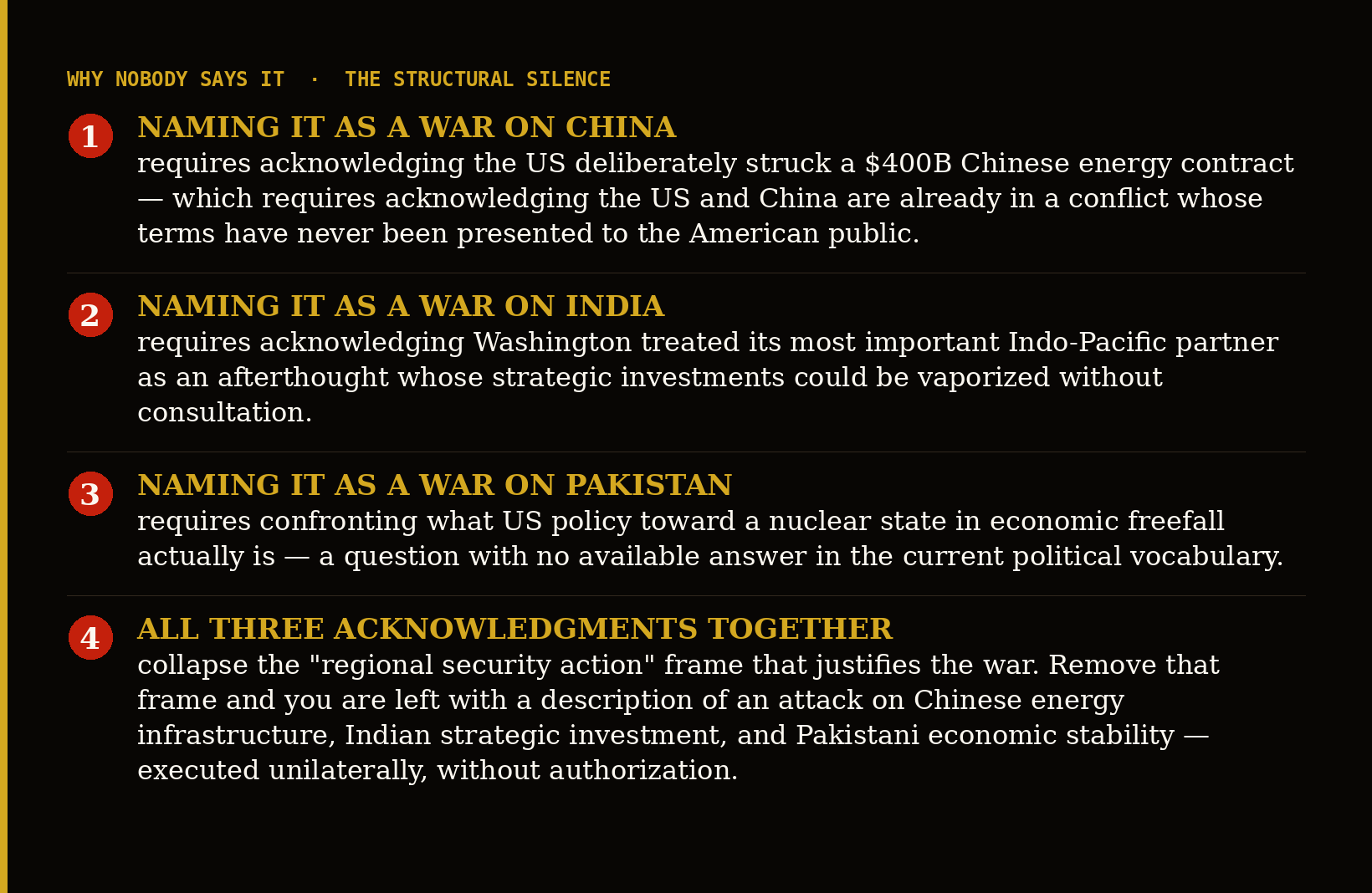
None of those acknowledgments are available in the current political vocabulary. The war is framed as a security action against Iran’s nuclear program and regional influence. That frame is load-bearing. Remove it and you are left with a description of an attack on Chinese energy infrastructure, Indian strategic investment, and Pakistani economic stability — executed unilaterally, without authorization, by an administration simultaneously running a protection racket against its own allies through tariffs.
Beijing has been very effective at playing the role of proactive engagement with Iran, but hasn’t really backed up a lot of the talk with concrete initiatives on the ground.5 That asymmetry — the gap between the paper contract and the realized investment — is the only thing that prevents this from being a cleaner case. China is an economic victim of a war on its contracted partner. Not a victim the way a country at war is a victim. A victim the way a creditor is a victim when the collateral burns.
But creditors respond. They don’t call press conferences. They restructure the architecture. They build the rail lines that bypass the destroyed infrastructure. They deepen the settlement systems that bypass the dollar. They welcome the Sunni oilers who just watched their strait get closed by the same power that was supposed to guarantee its safety.
The Reframe
The Contract Is the Context · Effect Is Not Opinion · The Silence Is the Tell
The 2021 Iran-China partnership is not a curiosity. It is the legal and economic context inside which the 2026 war must be understood. Without it, the war looks like a regional security action with unfortunate economic side effects. With it, the war looks like a strike on a Chinese strategic asset, executed through a proxy target, in a theater where the US can claim defensive justification while the economic damage accrues to Beijing, New Delhi, and Islamabad.
Whether that was the intent is a question for historians. Whether that is the effect is not.
References & Sources
1
Farnaz Fassihi & Steven Lee Myers, New York Times (March 27, 2021) China, with $400 Billion Iran Deal, Could Deepen Influence in Mideast
2
Axios (March 27, 2021) Iran, China sign 25-year cooperation agreement
3
Wikipedia Iran–China 25-year Cooperation Program — full background and leaked draft details
4
US-China Economic and Security Review Commission (March 16, 2026) China-Iran Fact Sheet: A Short Primer on the Relationship
5
The Wire China (March 16, 2026) How China Gets Caught Between Iran and the U.S.
6
Brookings Institution (January 27, 2026) How is China positioning itself as Iran’s regime teeters?
7
TIME Magazine (March 16, 2026) How the War With Iran Is Impacting Economies in Asia
8
The Quint (April 28, 2026) Iran War, China-Pakistan & Trumpification: What Loss of Chabahar Means for India
9
CNBC (March 10, 2026) China’s nudge, U.S. waiver and Iran tensions test India’s economic balancing act
10
The Global Economics (April 29, 2026) Oil Shock and Economic Strain: Asia Faces the Fallout of the Iran War
11
Middle East Institute (November 20, 2025) Obstacles and Opportunities for Closer Iranian-Chinese Economic Cooperation
12
China-US Focus (April 16, 2021) The China-Iran Comprehensive Strategic Partnership: Tip-Toeing Toward Significance
13
US-China Economic and Security Review Commission (June 2021) China-Iran Relations: A Limited but Enduring Strategic Partnership (PDF)
14
Rasanah — International Institute for Iranian Studies The Iran-China 25-Year Comprehensive Strategic Partnership: Challenges and Prospects
15
Brandeis University Crown Center (April 28, 2021) The Iranian-Chinese Strategic Partnership: Why Now and What it Means
16
Cambridge University Press / Association for Iranian Studies (2026) Between “New Axis of Evil” and “Paper Tiger”: Expectations and Reality of the 25-Year Iran-China Cooperation Agreement