
Can and May
The BRICS+ Perception Horizon and What America Is Choosing to Lose

DULY CONSIDER · GEOPOLITICS · THE PERCEPTION HORIZON · MAY 2026
GEOPOLITICS SERIES · PIECE FOUR · THE PERCEPTION ARGUMENT BRICS+ · WORLD ORDER · WHAT AMERICA IS CHOOSING TO LOSE
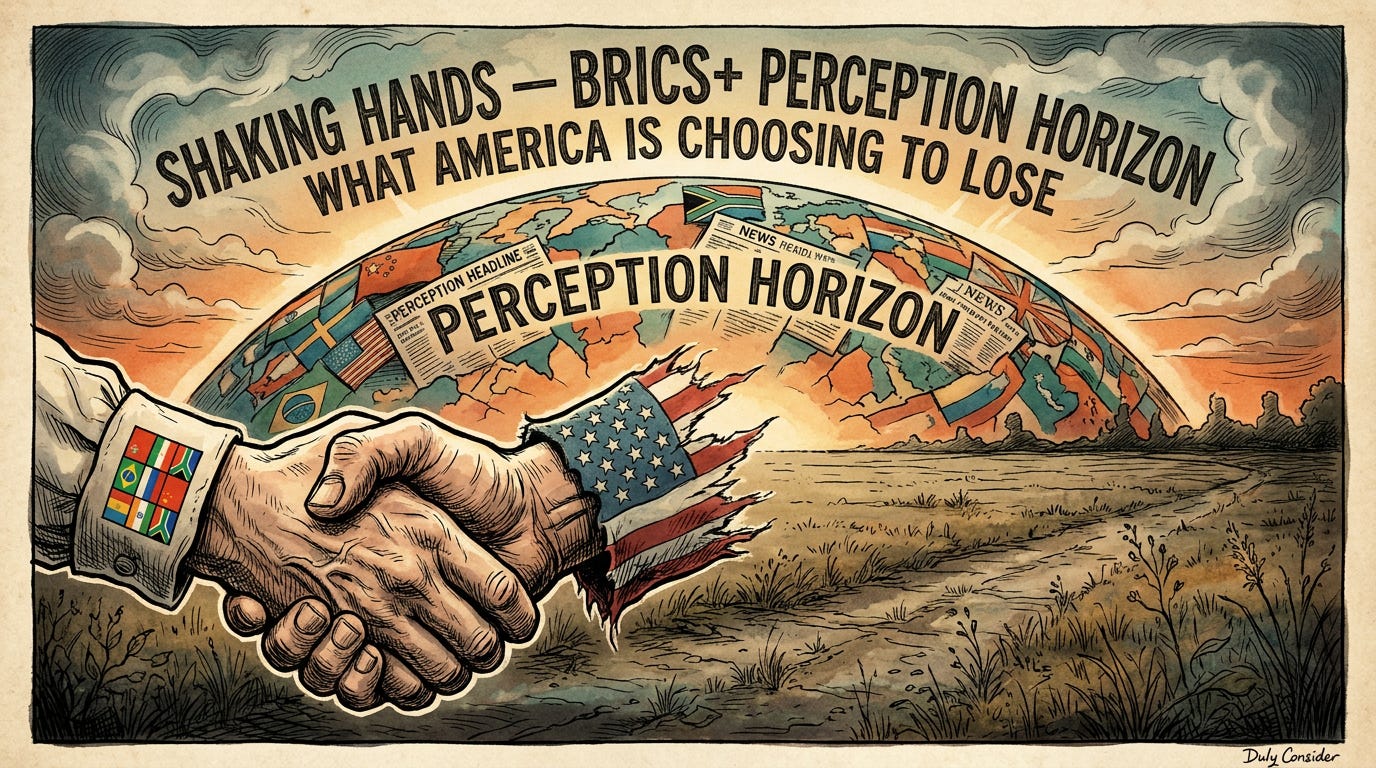
BRICS+ may or may not achieve true moral supremacy. It can and may achieve perceptual supremacy — and in geopolitics, perception is the variable that moves alignments. America is not losing to China. America is choosing to lose by abandoning the field.
This piece makes a specific distinction that the debate about China and American decline consistently fails to make. The question is not whether BRICS+ is morally superior to the American-led order. It is not. The question is whether BRICS+ can achieve perceptual supremacy in the eyes of the global south — and whether that perception shift, regardless of its accuracy, produces political alignments that reshape the world order. The answer to that question is yes, it can, and the mechanisms by which it does so are documented, timestamped, and already in motion.
A further distinction worth making at the outset: the American moral high ground narrative has always been partially constructed. The documented record of American conduct — slavery, the genocide of Indigenous populations, Jim Crow, the internment of Japanese Americans, coups and proxy wars across three continents, mass incarceration, and current support for military operations with documented civilian death tolls — is the record against which any claim of moral leadership must be measured. That record does not require China or Russia to be decent in order to indict it. It stands on its own.
What the current moment adds is this: the gap between the American claim and the American conduct has become visible at a scale that the propaganda cannot contain. The perception flip is not happening because China became decent. It is happening because America made the contrast less stark than the propaganda required it to be.
PART ONE
Perception Is the Variable
Not moral reality. Not true superiority. The variable that moves political alignments.
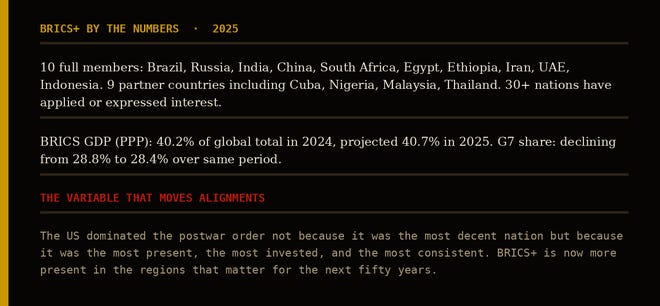
BRICS+ BY THE NUMBERS · 2025 · SOURCES: IMF WORLD ECONOMIC OUTLOOK, CARNEGIE ENDOWMENT, CFR
The United States dominated the postwar international order not because it was the most decent nation but because it was the most present, the most invested, and the most consistent in showing up. Marshall Plan. Bretton Woods. The UN architecture. The World Bank. The IMF. Whatever the failures and hypocrisies of those institutions, they represented American presence in the regions and relationships that shaped the postwar world.
BRICS countries now account for 40.2% of global GDP measured by purchasing power parity, with projections rising to 40.7% in 2025, while the G7’s share is expected to decline from 28.8% to 28.4% over the same period. The bloc now includes ten full members — Egypt, Ethiopia, Iran, and the UAE joined in 2024, Indonesia in January 2025 — with nine partner countries and some two dozen nations having expressed interest in joining.
Crucially: Cuba is among the nine BRICS partner nations. The country the US has blockaded for sixty years is now formally affiliated with the bloc that is challenging American-led institutions. That is not a coincidence. It is a signal about where the global south believes its interests lie.
America did not lose the global south’s confidence because China is decent. It lost it because America stopped showing up — and then made it worse by actively arming the argument against itself.
PART TWO
The Delivery Test
Timestamped predictions. If China delivers on half of these, the perception shift is irreversible.
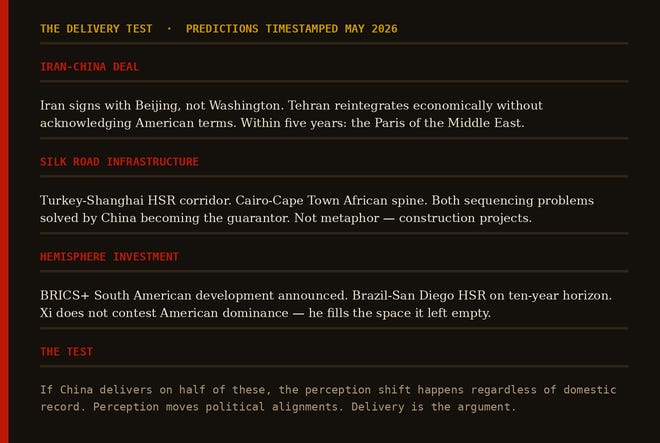
THE DELIVERY TEST · PREDICTIONS TIMESTAMPED MAY 2026 · CHECK BACK IN FIVE YEARS
The perception argument lives or dies on delivery. China’s advantage over American rhetoric is precisely this: it builds things. The Belt and Road was not a diplomatic statement. It was concrete and steel in countries that had been waiting for infrastructure investment for generations. The question is not whether China’s motives are pure — they are not, debt structures and strategic dependencies are real — but whether the infrastructure serves the populations in those regions better than the alternative they were actually being offered, which in many cases was nothing.
The specific predictions this series has timestamped — the Iran-China comprehensive partnership, the Turkey-Shanghai HSR corridor, the African spine from Cairo to Cape Town, the BRICS+ hemisphere investment — are the delivery test. China has jointly issued a six-point consensus with Brazil on a political solution to the Ukraine crisis and launched a “Friends of Peace” group with other Global South countries. The diplomatic architecture is being built alongside the physical one.
If China delivers on half of these predictions within a decade, the perception shift in the global south is irreversible. Not because China became decent. Because China showed up and built something, and the alternative didn’t.
PART THREE
The Cuba Tipping Point
The Monroe Doctrine meets the multipolar moment. The bluff that cannot afford to be called.
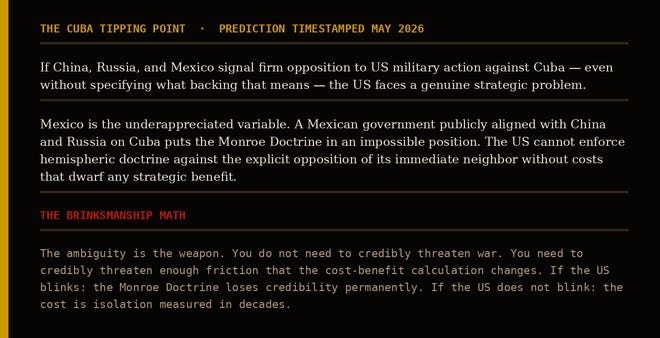
THE CUBA TIPPING POINT · PREDICTION TIMESTAMPED MAY 2026 · CUBA IS A BRICS+ PARTNER NATION
Cuba is now a BRICS+ partner nation. That fact changes the strategic calculation around any American military action against the island in ways that have not been fully absorbed by Washington’s foreign policy establishment.
If China, Russia, and Mexico signal firm opposition to American military action against Cuba — even without specifying what backing that signal means — the US faces a genuine dilemma that the Monroe Doctrine’s architecture was never designed to handle. The ambiguity is the weapon. You do not need to credibly threaten war to change a cost-benefit calculation. You need to credibly threaten enough friction that the expected value of action turns negative.
Mexico is the variable that matters most and receives the least attention. A Mexican government that publicly aligns with China and Russia on Cuba puts the Monroe Doctrine in an impossible position. The US cannot enforce hemispheric doctrine against the explicit opposition of its immediate southern neighbor without costs — economic, diplomatic, and domestic political — that dwarf any conceivable strategic benefit from Cuba.
If the US blinks in that scenario, the Monroe Doctrine loses credibility permanently — not just in Cuba but across the hemisphere. Every government watching will update its assessment of American resolve and American reach. If the US does not blink, the isolation is measured in decades. The hand is a bluff that cannot afford to be called. That is the definition of a weak position.
PART FOUR
What Americans Should Actually Demand
America is not losing to China. America is choosing to lose. That choice is reversible.
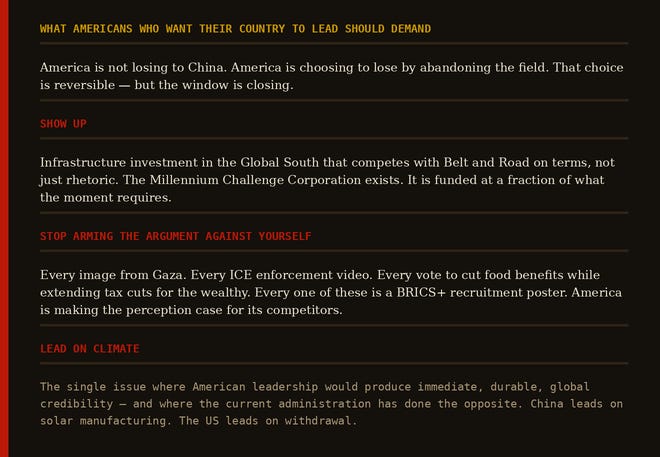
WHAT AMERICANS WHO WANT THEIR COUNTRY TO LEAD SHOULD ACTUALLY BE DEMANDING
The perception flip is not inevitable. It is the current trajectory given current conduct. That trajectory is a choice, and choices can be reversed.
The argument that BRICS+ is winning the perception war is strongest in the specific regions where American presence has been absent or actively harmful. It is weakest where American investment, diplomacy, and genuine partnership have been sustained. The problem is that the list of the latter has been shrinking while the list of the former has been growing — by deliberate policy choice, not by structural inevitability.
Show up. The Millennium Challenge Corporation exists. The Development Finance Corporation exists. American universities, American technology, American agricultural expertise, American public health infrastructure — these are genuine assets the global south wants access to. The competition with China for development partnerships is one America can win if it chooses to enter it. It has largely chosen not to.
Stop arming the argument against yourself. Every image from Gaza that circulates on social media in the global south. Every ICE enforcement video. Every congressional vote to cut food benefits while extending tax cuts for the wealthy. Every one of these is a BRICS+ recruitment poster produced at American expense. The gap between stated values and actual conduct is the raw material of the perception shift. Closing that gap is the only argument that works.
Lead on climate. The single issue where American technological capacity, financial resources, and genuine global leadership would produce immediate, durable credibility with the populations that matter most for the next fifty years. China leads on solar manufacturing. The current American administration leads on withdrawal. That is a choice with consequences that will outlast the administration that made it.
BRICS+ can and may achieve perceptual supremacy. Whether it achieves it depends more on what America chooses to do than on what China chooses to build. That is the honest assessment. The field is being abandoned, not conquered.
The open question — the one this series leaves open honestly — is whether BRICS+ delivering perceptual supremacy benefits the actual citizens of the global south. Infrastructure built on debt structures that create strategic dependencies is not the same as development that serves the populations it reaches. The citizens of South America, Africa, and the Silk Road corridor deserve more than a choice between American neglect and Chinese leverage. They deserve genuine partnership from whoever has the capacity to provide it.
America still has that capacity. The question is whether it has the political will to use it — before the perception shift becomes the reality shift, and the field that was abandoned becomes the field that cannot be reclaimed.
THIS SERIES · GEOPOLITICS FOUR PARTS
Piece Four: Can and May — This piece.
REFERENCES
1
2
CARNEGIE ENDOWMENT FOR INTERNATIONAL PEACE (MARCH 31, 2025) BRICS Expansion and the Future of World Order — October 2024 Kazan summit; Egypt, Ethiopia, Iran, UAE joined 2024; Indonesia January 2025; nine partner countries; two dozen nations have applied or expressed interest
3
COUNCIL ON FOREIGN RELATIONS (JUNE 26, 2025) What Is the BRICS Group and Why Is It Expanding — eleven-strong bloc; divisions among members on Russia-Ukraine; Brazil’s 2025 leadership focus on Global South cooperation; growing heft and new disagreements
4
PEOPLE’S DAILY ONLINE (JANUARY 9, 2025) BRICS expansion shows global shift — Indonesia formally joined January 2025; Malaysia and Thailand as partner states; 30+ nations formally applied to join; growing vitality and influence on global stage
5
CENTRE FOR INTERNATIONAL GOVERNANCE INNOVATION With BRICS Expansion, the Global South Takes Centre Stage — enlarged BRICS will represent more than quarter of world GDP; India the least willing to go all-in; South Africa’s Ramaphosa: “a world that is fair, just, inclusive and prosperous”
6
DULY CONSIDER — BRYAN E. HALL Silk Road: Adults in the Room — Piece One of this series; the Iran announcement; the South American announcement; the infrastructure that makes the perception shift permanent