
The Class Exemption
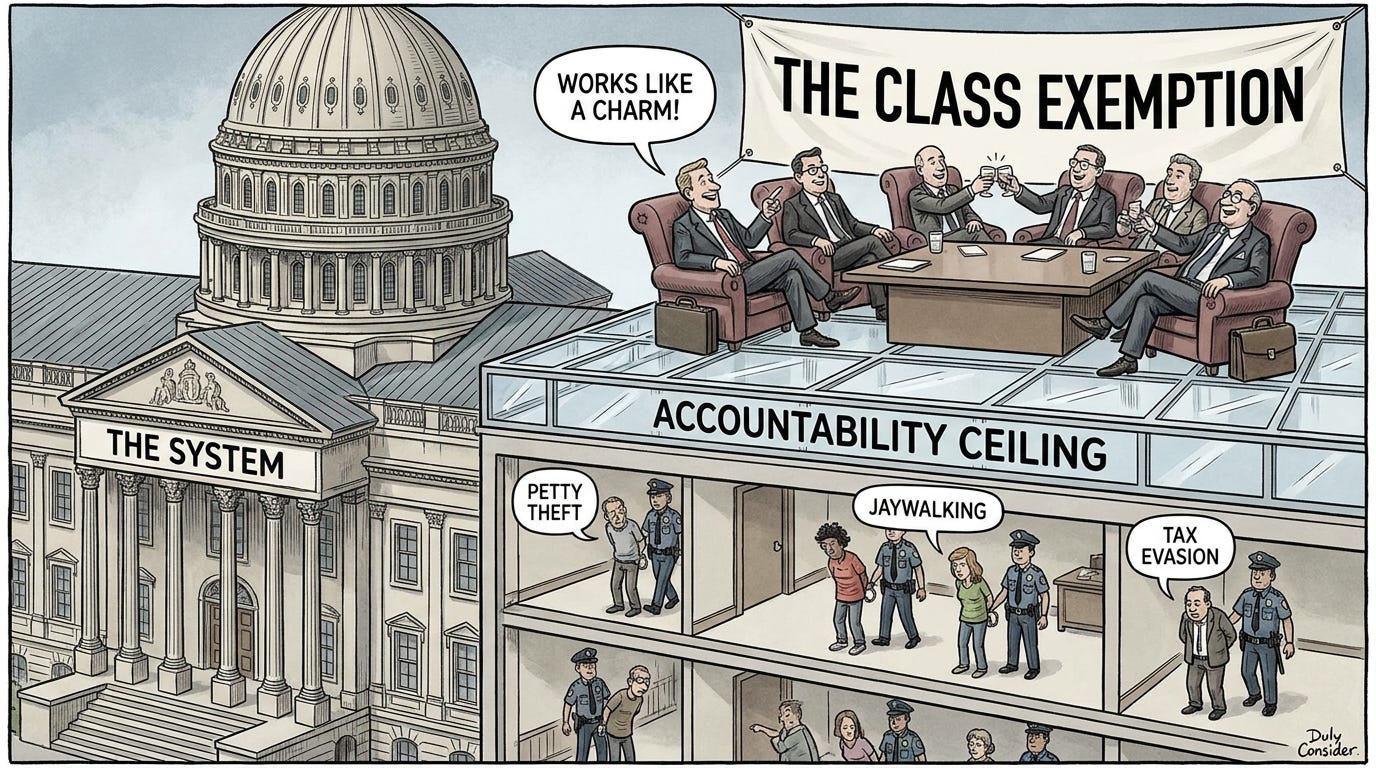
Criminal accountability in America has a ceiling. It stops exactly where the most consequential decisions are made. This is not a failure of the system. It is the system working as designed.

POLITICS · ACCOUNTABILITY · THE PYRAMID · MAY 2026
ESSAY ONE OF TWO · ACCOUNTABILITY · CRIMINAL LAW · CLASS
CONNECTED READING What FDR Actually Said — companion essay: the reform offer that the class exemption makes necessary The Sentinel Compact: Who Stops the Machine Pity the Billionaire: The Class Indictment Death by 1,000 Cuts: The Extraction Ledger
The principle is not contested. Serious consequences follow serious harm. We apply it every day. A man sells crack in a stairwell and draws three to ten federal years. A woman kites checks and faces eighteen months. A contractor defrauds Medicare and serves time. The logic is stated plainly in every sentencing memorandum: the severity of the conduct warrants the severity of the sanction. Deterrence requires it. Justice demands it. We are consistent about this. We are consistent about this until the harm becomes so large, and the people who caused it become so wealthy, that the principle quietly reclassifies itself as inapplicable.
This essay documents that reclassification. It does not assert guilt the legal system has not assigned. It does not claim conspiracy where pattern suffices. It applies the standard this publication applies to every power structure: look at the behavior, the documented record, and the architecture of evasion. Then draw the conclusions the evidence permits.
PART ONE
The Receipts
Start with the numbers, because the numbers are the argument.
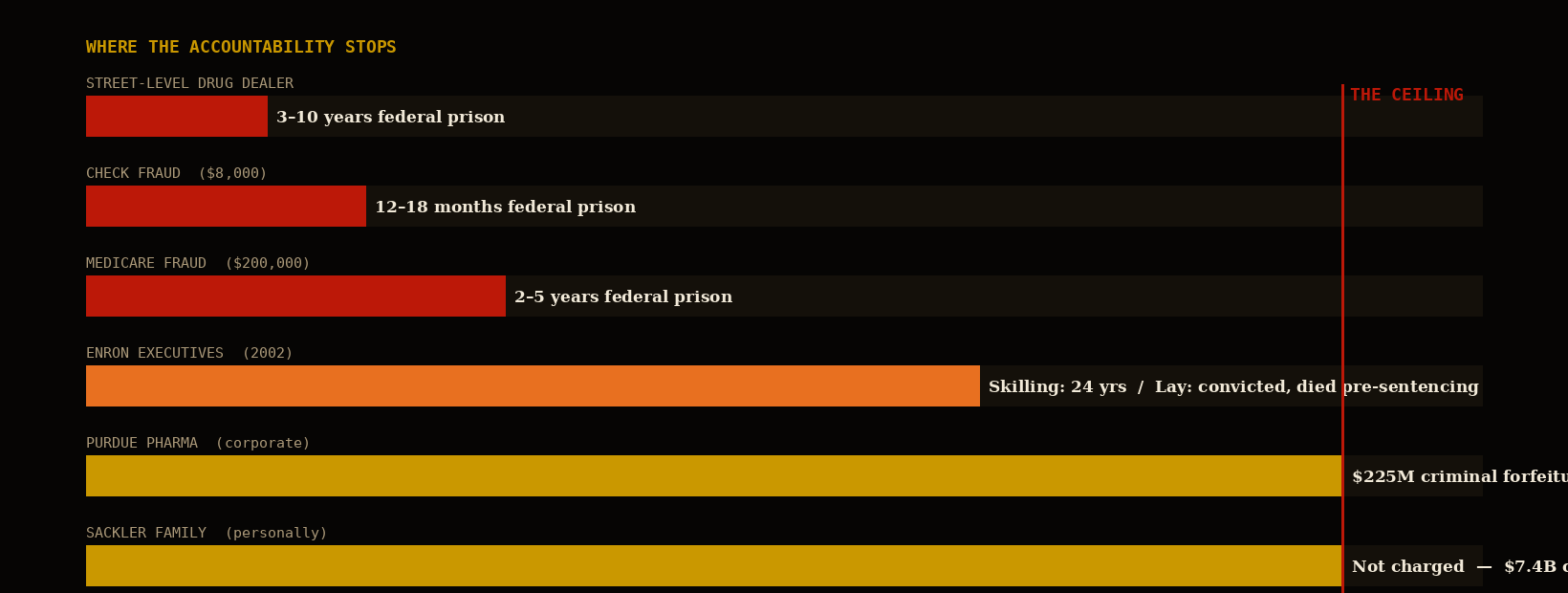
THE CEILING — ACCOUNTABILITY BY HARM SCALE · COMPILED FROM FEDERAL SENTENCING DATA AND DOCUMENTED CASE OUTCOMES
The chart above is not editorial. Every entry is a documented federal outcome. The pattern it reveals — accountability scaling upward through the middle, then collapsing at the top — is the argument. Not an interpretation of the argument. The argument itself.
Purdue Pharma pleaded guilty to federal criminal charges twice. The company, not the people who ran it.1 Eight hundred thousand Americans are dead from opioid overdoses between 1999 and 2023. The Drug Enforcement Administration has known since 2002 that Purdue’s marketing practices were driving diversion and overdose. Internal documents released through litigation show that Richard Sackler, then a top Purdue executive, called for a “blizzard of prescriptions” at a 1996 company rally.2 The Sackler family took in $35 billion in OxyContin revenue between 1995 and 2017. Anticipating liability, they moved money out of Purdue into personal trusts — a decision documented in a 2006 DOJ memo that did not become public until years later.3

THE SACKLER LEDGER · COMPILED FROM DOJ SENTENCING DOCUMENTS AND BANKRUPTCY COURT FILINGS, APRIL 2026
The final settlement: $7.4 billion paid over fifteen years. No admission of fault. No criminal charge against any Sackler family member.4 Fewer than half of those who filed claims will receive any payment at all.5 The DOJ accepted the $225 million criminal forfeiture, agreed not to collect a further $8.1 billion in potential criminal and civil penalties, and issued a statement calling Purdue’s conduct an example of putting “profits over patient health and safety.” The statement is accurate. The accountability that would normally follow is absent. No prosecutor has explained, in writing, why the documented conduct of the people who ran Purdue does not meet the standard applied to defendants who cause far fewer deaths with far less organizational infrastructure.
The Sacklers are not exceptional. They are illustrative. The pattern predates them, postdates them, and operates through an architecture that was not assembled by accident.
PART TWO
The $11 Part
In 1973, Ford Motor Company prepared an internal cost-benefit analysis on a known defect in the Pinto’s fuel system. The document, later obtained through litigation and known as the “Pinto Memo,” laid out the calculation explicitly. Fixing the defect would require an $11 plastic shield or tank reinforcement per vehicle. At 12.5 million total units, the cost was $137 million. Projecting 180 burn deaths and 180 serious injuries across 2,100 accidents, and valuing a human life at $200,000, a serious injury at $67,000, and a vehicle at $700, the total liability cost came to $49.5 million. The conclusion: absorb the lawsuits.6 The fix would cost $87.5 million more than letting people burn.
Conservative estimates put Pinto fire deaths at five hundred over the production run. A federal jury convicted Ford of nothing in the 1980 Indiana criminal trial — the prosecution was limited to conduct after 1977, when Indiana’s reckless homicide law was enacted, and was blocked from introducing the internal documents.7 The executives who made the decision that $200,000 per human life was an acceptable ceiling served no prison time. Ford issued a recall in 1978 under public pressure. The recall came after the deaths. The memo was written before them.
This is not a historical anomaly. It is the template. Calculate the cost of compliance against the cost of liability. If liability is cheaper, absorb it. Ensure the documentation remains internal as long as possible. Settle quietly, with nondisclosure agreements where available. When the documents surface, attribute the conduct to the company rather than the individuals. The company is a legal fiction. It cannot be imprisoned. That is its function.
PART THREE
What They Knew and When They Knew It
The tobacco case is the most thoroughly documented example of corporate leadership maintaining a public position they knew internally to be false, doing so under oath before Congress, and facing no individual criminal accountability for the knowing falsity.

APRIL 14, 1994 — CONGRESSIONAL TESTIMONY · SOURCES: ENCYCLOPEDIA.COM / 60 MINUTES / AMERICAN ASSOCIATION FOR CANCER RESEARCH
The internal documents tell the story that the congressional testimony did not. A 1961 Arthur D. Little report prepared for Liggett and Myers identified biologically active materials in cigarette tobacco as “cancer causing,” “cancer promoting,” and “poisonous.” A 1962 R.J. Reynolds internal report characterized the evidence implicating smoking as a health risk as “overwhelming.”8 By the 1950s, according to the American Association for Cancer Research’s review of the disclosed documents, tobacco executives “knew and for the most part accepted the evidence that cigarette smoking was a cause of cancer.”
In 1994, the CEOs of seven major tobacco companies raised their right hands before Congress and stated that they believed nicotine was not addictive and that cigarettes had not been proven to cause cancer. One month later, a box of Brown & Williamson internal documents was delivered anonymously to the University of California at San Francisco.9 Dr. Jeffrey Wigand, then the vice president for research at Brown & Williamson, confirmed on the record what the documents showed: the company had known and actively suppressed the science. The 1998 Master Settlement Agreement cost the companies $206 billion, paid over twenty-five years. Not one tobacco executive served time for perjury. The Congress before whom they lied did not refer a single executive for prosecution. The Department of Justice, which brought a civil RICO case against the industry in 1999, did not bring perjury charges.
The application of the “collateral consequences” framework — the principle that prosecution of major institutions or their leaders might harm the economy — is not unique to financial institutions. It applies, with some variation in the stated rationale, across every sector where the harm is large enough and the defendants wealthy enough. This is the architecture. It was not written in a single memo. It accumulated.
PART FOUR
Too Big to Jail
In 2013, Attorney General Eric Holder told the Senate Judiciary Committee that the size of some financial institutions had become “so large that it does become difficult for us to prosecute them,” because a criminal charge might have “a negative impact on the national economy, perhaps world economy.”10 He later walked this back. He did not walk back the outcomes. Not one senior Wall Street executive was criminally prosecuted for the conduct that produced the 2008 financial crisis — the largest economic catastrophe since the Great Depression, which destroyed $11 trillion in household wealth and cost eight million Americans their jobs.
The Financial Crisis Inquiry Commission sent eleven criminal referrals to the Justice Department, involving multiple high-level executives and companies. The Justice Department acted on none of them at the individual level.11 The banks paid civil fines. The fines were written off as business expenses. The executives kept their bonuses. In some cases, they negotiated more favorable settlement terms than the original “take it or leave it” offer — as HSBC did in 2012, after British officials lobbied the Federal Reserve chairman and the Treasury Secretary on the bank’s behalf.12
The former career prosecutor Paul Pelletier, who left the Justice Department out of frustration during this period, said it plainly: “People didn’t get prosecuted during the financial crisis or high level executives simply because of a lack of commitment, competence, and courage by the political leaders in the Department of Justice.”13
The Holder memo on “collateral consequences” was written in 1999. The revolving door between Covington & Burling — the firm that represents the banks — and the DOJ leadership that prosecuted them operated in both directions. You are not required to call this a conspiracy. You are permitted to note that it is a fact.
PART FIVE
By Design, By the People at the Top, Through the Architecture They Fund
The exemption is not a legal concept. It does not appear in any statute. It is an operational pattern — a consistent set of outcomes produced by a consistent set of structural arrangements. Name the architecture, because the architecture is the admission.
The “collateral consequences” memo that became the operating framework for financial institution prosecutions was written by the man who later became attorney general. The revolving door between elite defense firms and DOJ leadership is documented and routine. The McDonnell decision — in which the Supreme Court narrowed the definition of an “official act” in bribery law to exclude nearly everything senior officials actually do — was argued by counsel who had represented corporate defendants and is now cited in every public corruption defense.14 The bankruptcy protection that shielded Purdue’s principals from future civil suits was architected by attorneys whose fees were paid from the estate. The 1998 tobacco settlement was negotiated by state attorneys general who later became lobbyists for the industry.
None of this is secret. All of it is legal. The legality is the point. A system of rules that produces this pattern of outcomes — accountability descending without exception until it reaches the people who make the most consequential decisions, then stopping — is a system that was built to produce that pattern. The alternative explanation is that the most sophisticated legal apparatus in human history accidentally calibrated its enforcement mechanisms to systematically exempt the actors with the most resources from the consequences it applies uniformly to everyone else. That explanation requires more credulity than the pattern warrants.
We already accept that serious consequences follow serious harm. That principle is not contested. It is applied every day, in every federal district, to defendants who cannot afford the attorneys who write the memos that create the exceptions. The class exemption is not a departure from the rule. It is the rule’s other side.
The ceiling is not a bug. It is load-bearing.
REFERENCES — THE CLASS EXEMPTION
1
NPR (APRIL 29, 2026) Purdue Pharma sentenced in criminal opioid case while company leaders avoid charges — the second guilty plea, the corporate penalty, the individual impunity
2
PBS NEWSHOUR (APRIL 2026) Richard Sackler’s 1996 “blizzard of prescriptions” rally; the $225M criminal forfeiture; the $5.3B criminal penalty the DOJ agreed not to collect
3
LIBERATION NEWS (MAY 2026) The 2006 DOJ memo documenting Sackler family knowledge; the asset transfer from Purdue to personal trusts in anticipation of liability
4
LAWYER MONTHLY (APRIL 2026) No criminal charges against Sackler family members despite decades of documented board-level control; 2024 Supreme Court ruling in Harrington v. Purdue Pharma and its limits
5
PROPUBLICA (APRIL 2026) Fewer than half of claimants will receive payment under the $870M individual victim fund; $7.4B settlement structure and distribution
6
MEDIUM / DICK BATCHELDER (FEBRUARY 2026) Ford Pinto Memo full cost-benefit analysis: $11 fix vs. $49.5M projected liability; the $200,000 per life valuation; $137M vs. $49.5M
7
CE ENGINEERING / FORD PINTO ETHICS ANALYSIS The 1980 Indiana trial procedural limitation to post-1977 conduct; internal document inadmissibility; the not-guilty verdict’s scope
8
AMERICAN ASSOCIATION FOR CANCER RESEARCH (2007) Internal industry documents showing tobacco company knowledge of carcinogenesis by late 1950s; 1961 Liggett/Arthur D. Little report; 1962 R.J. Reynolds “overwhelming” evidence assessment
9
ENCYCLOPEDIA.COM / UCSF TOBACCO DOCUMENTS April 1994 congressional testimony; the Brown & Williamson document leak; Jeffrey Wigand; 1998 Master Settlement Agreement
10
PBS FRONTLINE (2013) Holder’s “Too Big to Jail” Senate testimony; subsequent walk-back; no senior Wall Street prosecutions from 2008 crisis
11
MARKETPLACE / FEATURES (2020) The eleven criminal referrals from the Financial Crisis Inquiry Commission; DOJ inaction; zero senior executives prosecuted
12
THE INTERCEPT (JULY 2016) HSBC money laundering; British government intervention; the “take it or leave it” offer that HSBC still negotiated; internal Treasury emails documenting DOJ hesitation
13
BILL MOYERS / PBS (2014) Paul Pelletier on DOJ leadership failure; William K. Black on the savings and loan comparison; the Covington & Burling revolving door
14
DULY CONSIDER — FARA/AIPAC LEGAL FRAMEWORK The McDonnell v. United States narrowing of “official act” in bribery law and its application across corporate and political corruption defense
COMPANION ESSAY What FDR Actually Said → How open discussion of revolutionary consequence produced the reform alternative — and why the class exemption documented here is precisely what the offer was designed to prevent.