
What FDR Actually Said
Roosevelt did not persuade the business community that reform was fair. He persuaded them it was the alternative to the Romanovs. The discussion was not a threat. It was the prevention.

POLITICS · ACCOUNTABILITY · THE PYRAMID · MAY 2026
COMPANION ESSAY The Class Exemption → The documented accountability ceiling — Sacklers, 2008 executives, Ford Pinto, Big Tobacco — that makes the offer described in this essay necessary.
ESSAY TWO OF TWO · HISTORY · REFORM · THE CREDIBLE ALTERNATIVE
CONNECTED READING The Class Exemption — companion essay: the documented accountability ceiling this piece is the answer to The First 200 Years and the Second 80: The Mechanism Pity the Billionaire: The $8.5 Trillion They Left Out The Sentinel Compact: The Constructive Answer
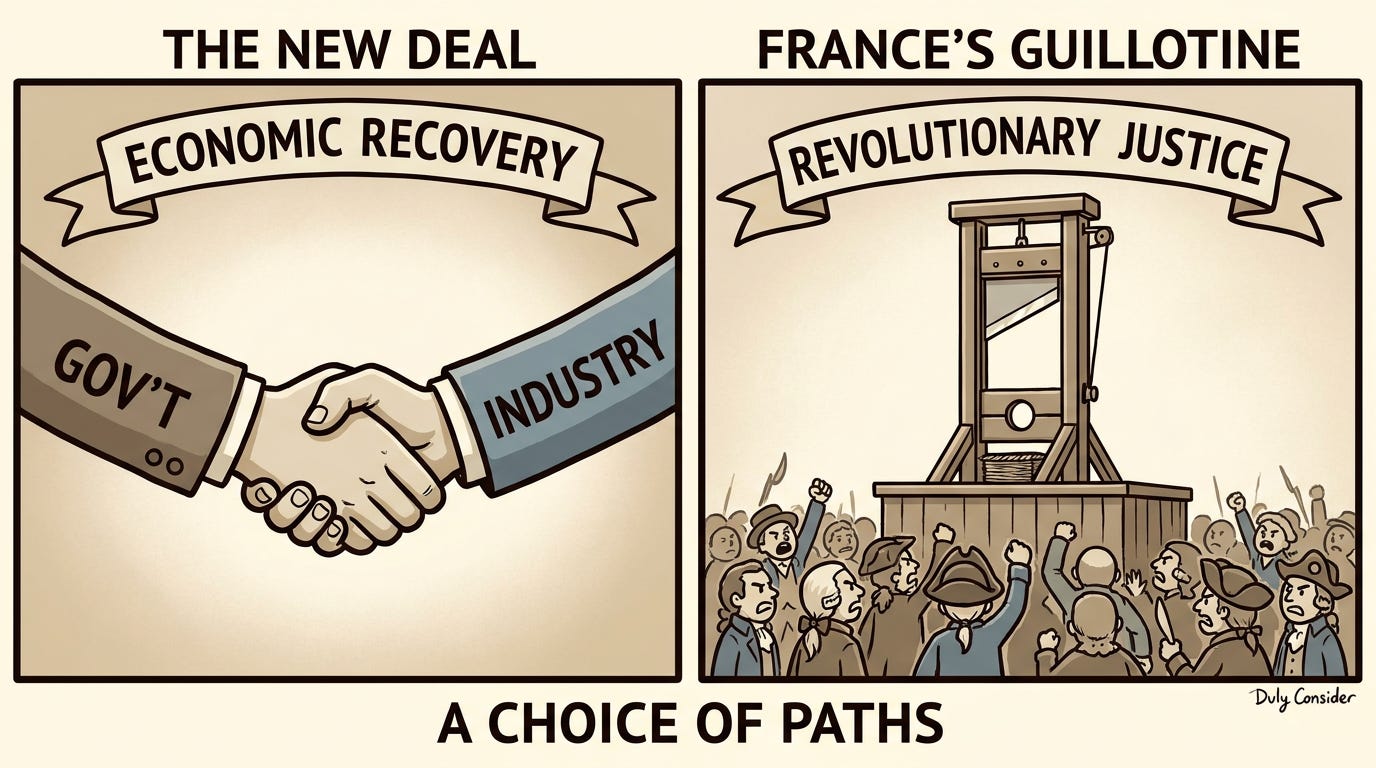
The version that survives in popular memory is of Roosevelt as reformer — the humane architect of the welfare state, the president who believed in the little man, who taxed the wealthy because he thought they should pay their share. This version is not wrong. It is incomplete in a way that makes it useless for the present moment. The actual historical argument was starker, more precise, and far more instructive than the one we inherited. Roosevelt did not ask the business community to accept reform because it was just. He told them to accept it because the alternative was what happened to the Romanovs.
This essay is about the thing he actually said, the structural logic underneath it, and why the discussion of revolutionary consequence was not incitement. It was the mechanism that made revolution unnecessary. The argument applies directly to now.
PART ONE
The Condition of the Offer
By 1933, American capitalism was failing in public. Industrial production had fallen by nearly half since 1929. One quarter of the workforce was unemployed. Banks had failed by the thousands. The Socialist and Communist Parties were gaining membership. Huey Long was promising to redistribute wealth through a share-the-wealth program with a national following. Father Coughlin was broadcasting to tens of millions, moving toward positions that would later align with fascism.1 The radical alternative was not a theoretical possibility. It was organizing in the streets.
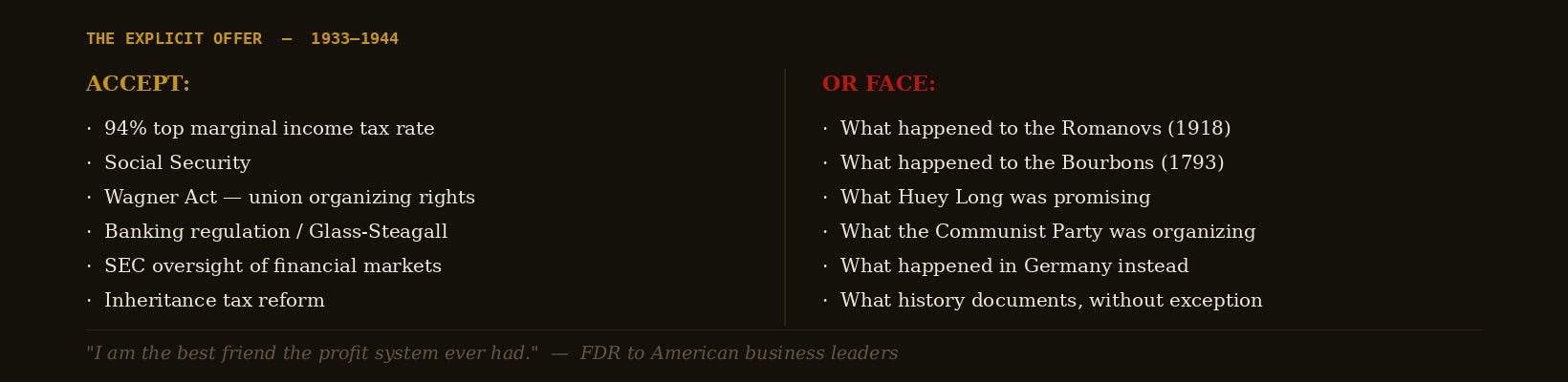
Into this environment, Roosevelt told business leaders explicitly what the offer was. He later said he was “the best friend the profit system ever had.”2 This was not a boast about his affection for capital. It was a description of a transaction. To save capitalism from its opponents — and from itself — he stated that he might have to “equalize the distribution of wealth,” which could mean throwing to the wolves the forty-six men reported to have incomes exceeding one million dollars a year.3 Huey Long immediately accused him of stealing Long’s own program. The accusation was accurate.
The implicit and sometimes explicit reference to what had happened in Russia in 1917, and in France in 1793, was not rhetorical flourish. It was the informational content of the offer. The Romanov dynasty, which had ruled Russia for three hundred years, was executed in a basement in Yekaterinburg in July 1918. The Bourbons were removed, tried, and guillotined. The question Roosevelt was posing to American business was not whether they found the New Deal’s terms acceptable in an ideal world. It was whether they found the terms acceptable in the only world that existed — one where the organized alternative was visible, staffed, and growing.
PART TWO
The Terms
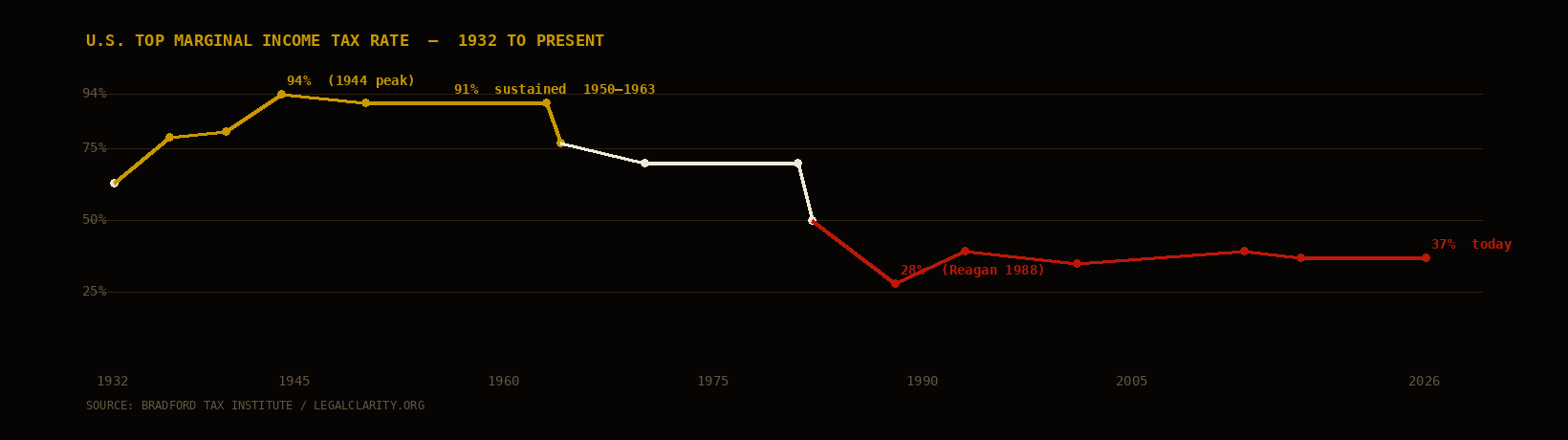
The terms were specific. Accept the National Labor Relations Act — the Wagner Act — which guaranteed workers the right to organize and bargain collectively. Accept Social Security, which created a federal pension and unemployment insurance system. Accept the Securities and Exchange Commission, which placed federal oversight on the financial speculation that had produced the crash. Accept banking regulation. Accept a top marginal income tax rate that would reach 77 percent in 1936 and climb to 94 percent by 1944.
U.S. TOP MARGINAL INCOME TAX RATE 1932–2026 · SOURCE: BRADFORD TAX INSTITUTE / LEGAL CLARITY
Roosevelt wanted the top rate to be 100 percent. He told the country in a 1942 radio address: “I do not think that any American citizen should have a net income in excess of $25,000 per year after payment of taxes.”4 Congress settled for 94 percent on income above $200,000 — roughly $3.4 million in today’s dollars. The rate held at 91 percent from 1950 until 1963. The postwar boom — rising wages, mass homeownership, union density peaking in the 1950s, the creation of the American middle class — occurred entirely within this tax environment. This is not offered as proof of causation. It is offered as a datum the people who call these rates confiscatory consistently omit.
The business community’s reaction to the New Deal was not acceptance. It was fury. The American Liberty League and the National Association of Manufacturers spent millions opposing Social Security and the Wagner Act. Conservative justices struck down several New Deal statutes as unconstitutional. Corporations placed notices in workers’ pay envelopes in 1936 warning them that Social Security would take money from their wages and might never return it.5 This resistance is important to the argument: the reform was not welcomed. It was imposed on a class that had the resources to resist it. The reason they ultimately absorbed it is precisely what this essay is about.
PART THREE
The Mechanism
The conventional account of why the New Deal succeeded — and why socialist revolution did not follow the Depression — emphasizes Roosevelt’s political skill, his coalition building, the Democratic majority, the force of his personal charisma on the radio. All of these are real. None of them is the explanation.
The explanation, documented by Seymour Martin Lipset and Gary Marks in their analysis of why socialism failed to take root in the United States, is that Roosevelt “consciously seeking to steal the thunder of his populist critics” shifted left in policy and made the credible radical alternative legible to the business community as the price of not accepting reform.6 The behavioral modification was achieved not because the business community was persuaded that 94 percent marginal rates were fair, but because they made the calculation. The alternative was Huey Long at full strength, or the Communist Party at full strength, or something worse, in a decade when Germany had demonstrated what happens when capitalist crisis is resolved by fascism rather than reform. The reform was the offer that made the alternatives unattractive.
THE EXPLICIT OFFER · THE REFORM ALTERNATIVE MADE LEGIBLE · 1933–1944
The discussion of revolutionary consequence was the prevention of it. This is the part the received history obscures. It was not that Roosevelt threatened the business community into compliance — the word “threat” suggests something illegal or illegitimate. He named the terrain honestly. He told them what the radical movements were promising, what the historical precedents showed happened to ruling classes that refused reform until the alternative was no longer reform, and he offered them a deal. The deal was the New Deal.
The discussion itself was the mechanism. Opening the question of what happens when reform is refused is not incitement. It is the argument that makes reform possible.
PART FOUR
What Happened When the Discussion Stopped
Beginning in the late 1970s and accelerating through the Reagan era, the New Deal framework was systematically unwound. The top marginal rate fell from 70 percent to 50 percent in 1981, then to 28 percent in 1988. Glass-Steagall — the banking regulation that separated commercial and investment banking — was repealed in 1999. Union density, which had peaked near 35 percent of the private workforce in the 1950s, collapsed to under 6 percent today. The speculative excess that Glass-Steagall was designed to prevent produced the 2008 financial crisis. The people who caused it were not prosecuted, as documented in the preceding essay.
The discussion of what follows from this trajectory — the discussion that Roosevelt conducted openly with the business community — became, in the intervening decades, unspeakable in polite political discourse. To name the structural analogy between 1932 and now was to invite accusations of radicalism. To say that concentrated wealth without accountability has a historical arc was to be called a demagogue. The result of closing the discussion was not stability. It was the suppression of the reform argument that might have produced the reform outcome.
The $8.5 trillion in unrealized gains sitting in the hands of the wealthiest Americans, undiscussed in *Pity the Billionaire*7, is the material. The political architecture that protects it from the taxation that funded the postwar boom is the mechanism. The silence about what historically follows from this combination is the precondition for the worst outcomes. The FDR lesson is not that you need a Roosevelt. It is that you need the honest discussion he was willing to have.
PART FIVE
The Application
The argument is not that revolution is desirable. It is not that revolution is imminent. It is not that naming historical precedents constitutes a call for violence. The opposite is true, and this is the argument Roosevelt understood and made explicit: the open discussion of what follows from entrenched inequality without accountability is the precondition for the reform that prevents the worst outcomes. The countries that suppressed the discussion did not thereby prevent the pressure. They prevented the valve.
The Bourbons did not see the guillotine coming because they had successfully made the discussion of it impolite. The Romanovs had survived 1905 without meaningful concession and concluded that survival was confirmation of the system’s stability. They were wrong about what stability was. Stability is not the absence of visible unrest. It is the presence of functional mechanisms for addressing legitimate grievance. When those mechanisms fail — when accountability has a ceiling, when the rules apply to the people below the ceiling and exempt the people above it — the question of what comes next is not a radical question. It is a historical one.
The Sentinel Compact, as documented in its founding essay, rests on four pillars: transparency, accountability, proportionality, and distributed power.8 These are not radical demands. They are the minimum conditions under which the system can continue to function without producing the outcomes that ended the Romanovs and the Bourbons. Roosevelt offered them to the American business community as a transaction: accept these conditions, or face what happens without them. The offer worked.
The offer has not been remade.
The class exemption documented in the preceding essay, the $8.5 trillion in untaxed gains, the accountability ceiling that stops exactly where the most consequential decisions are made — these are the conditions that historically produce the pressure Roosevelt knew how to relieve. The question is not whether someone will make the argument he made. The question is whether they will make it before the alternatives become the only options on the table.
PART SIX
The Offer, Remade
The actors have changed. The logic has not. In 1933 the offer was made to industrial capitalists and bankers — men who controlled steel mills and commercial banks, who funded political campaigns and sat on Federal Reserve boards. Today the same offer must be made to a different class of principals: the executives and shareholders of the military-industrial complex, the foreign influence infrastructure that funds the political class that authorizes the wars, and the financial architecture that converts instability into quarterly earnings. The terms of the offer follow from the documented record.
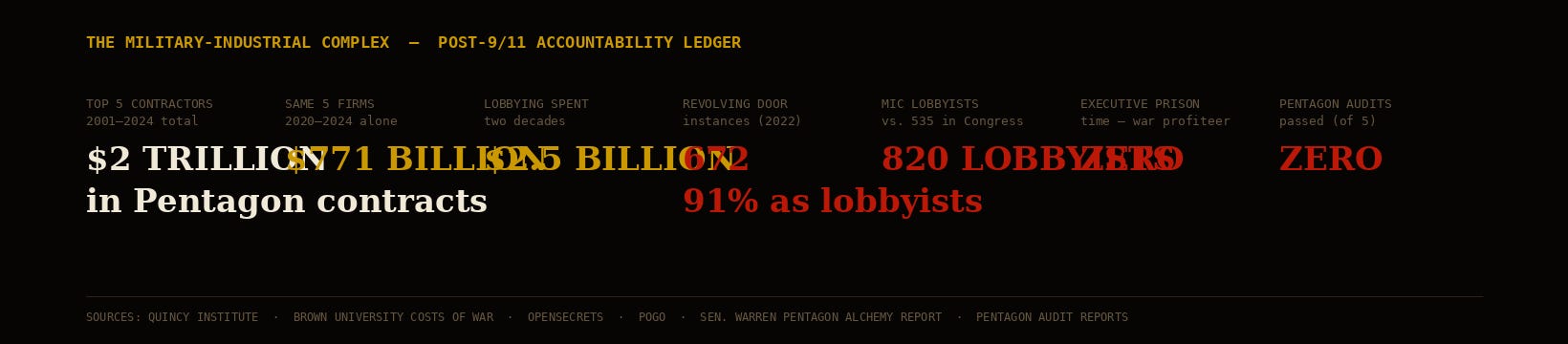
Start with what the record shows. Over two decades of post-9/11 wars in Afghanistan and Iraq, $2 trillion in Pentagon contracts went to just five companies: Lockheed Martin, RTX (formerly Raytheon), Boeing, General Dynamics, and Northrop Grumman.9 In the five years from 2020 to 2024 alone, those same five firms collected $771 billion in Pentagon contracts — more than twice what the United States spent on diplomacy, development, and humanitarian aid combined in the same period.10 Lockheed Martin’s $47.8 billion in Pentagon contracts in fiscal year 2024 exceeded the entire State Department budget.11 Since September 10, 2001, Lockheed Martin shareholders have seen returns of 1,163 percent — nearly three times the S&P 500.12
THE POST-9/11 MIC LEDGER · SOURCES: QUINCY INSTITUTE / BROWN UNIVERSITY COSTS OF WAR / OPENSECRETS / POGO / PENTAGON AUDIT REPORTS
To keep those contracts flowing, the industry spent $2.5 billion on lobbying over two decades and made $285 million in campaign contributions.13 It employed more than 820 lobbyists — more than one for every member of Congress — the majority of whom passed through the revolving door from the Pentagon or from congressional armed services committees directly into weapons-sector advocacy jobs.14 A 2023 Senate report documented 672 instances in a single year of former government officials, military officers, and congressional staff working as lobbyists, board members, or executives for the top twenty defense contractors; 91 percent of them became registered lobbyists.15 The Pentagon — the largest federal contracting agency in the country — has failed every one of its five attempted annual audits. Not one senior executive has faced criminal accountability for the waste, fraud, and overcharging that the Commission on Wartime Contracting estimated at between $31 billion and $60 billion in Iraq and Afghanistan alone.16
This is the class to whom the offer must be remade. Not because they are uniquely evil — the FDR argument never required moral transformation. It required only that the calculation become legible. The calculation is this: the architecture described above — the revolving door, the lobbying apparatus, the campaign finance infrastructure, the accountability ceiling documented in the preceding essay — is visible. It is documented. It is producing the pressure that historically precedes the kind of political rupture that ends the arrangements the class most wants to preserve.
The offer is not radical. It is the minimum transaction that makes the system survivable. FDR knew this. The business community of 1933 came to know it, under sufficient pressure. The question is whether the present class learns it the same way, or a harder one.
The mechanisms for the offer already exist in statute. The False Claims Act — Lincoln’s Law, passed in 1863 to combat war profiteering during the Civil War — imposes treble damages on contractors who knowingly defraud the government and empowers private whistleblowers to bring suit on the government’s behalf.17 It has recovered more than $75 billion since its 1986 amendments. It applies to every defense contractor in the country today. It is used routinely against mid-tier fraud. It is not applied to the senior executives who set the cost-accounting policies that produce the fraud. The statute does not prohibit this application. The class exemption does.
The Foreign Agents Registration Act already covers entities that act at the direction of a foreign principal. As documented in prior work on this publication, the evasion is architectural rather than legal — FARA was structured to exempt the lobbying infrastructure that functions as undisclosed foreign influence precisely because the architects of that infrastructure funded the campaigns of the people who write the exemptions.18 A DOJ with the same political will that prosecuted the savings and loan executives in the 1980s — when William Black’s team brought more than a thousand felony convictions — could apply the existing statute tomorrow. The law is there. The application depends on alignment.
The War Powers Resolution of 1973 requires congressional authorization for sustained combat operations. It has been systematically ignored by every administration since passage. A Congress that chose to enforce it — rather than to appropriate the funds that make its violation possible — would not need a new law. It would need only to stop passing the one it already writes every year.
None of these are radical proposals. They are the application of existing law to a class that has, through the architecture documented above, exempted itself from the application. The offer is not confiscation. It is not revolution. It is exactly what Roosevelt offered: accept the accountability architecture that makes the system legitimate, or face what historically follows from a system that is visibly structured to protect the people at the top from the consequences it imposes on everyone below them.
The FDR argument was not a threat. It was a description of the terrain. The Romanovs had survived 1905. The Bourbons had survived decades of mounting pressure before 1789. Both interpreted survival as confirmation of stability. It was not. Stability is not the absence of visible unrest. It is the presence of functional mechanisms for addressing legitimate grievance. The legitimacy of the grievance is not in dispute. Eight hundred thousand dead from opioids while the family that sold them retained billions and faced no criminal charge. Trillions in defense contracts to five companies whose stock returns depend on the continuation of conflicts their own revolving-door apparatus helps to authorize. A legal architecture that applies the principle of serious consequences for serious harm to every defendant who cannot afford the attorneys who write the exceptions.
The discussion of what follows from this — the honest, open, documented discussion that Roosevelt conducted with the American business community in the 1930s — is not incitement. It is the argument that makes the alternative unnecessary. Closing the discussion does not remove the pressure. It removes the valve.
He told them he was the best friend the profit system ever had. He was right. The profit system survived because he was willing to say what would happen if it didn’t change. The discussion was the prevention. The silence is what we should be afraid of.
REFERENCES — WHAT FDR ACTUALLY SAID
1
SOCIALIST ALTERNATIVE (2023) The radical context of the New Deal: Huey Long, Father Coughlin, Communist Party growth, the labor strike wave, and the organizing pressure that made reform politically necessary
2
MEDIUM / BEN AZZARA (MARCH 2026) FDR’s explicit statement to business elites that he was “the best friend the profit system ever had”; the reform-or-rupture frame he used
3
HOOVER INSTITUTION — LIPSET AND MARKS (2001) Roosevelt’s stated willingness to “throw to the wolves the forty-six men” with incomes above $1 million to save capitalism from its radical critics; Huey Long’s accusation that FDR stole his program
4
TIMOTHY NOAH / SUBSTACK FDR’s 1942 radio address: “I do not think any American citizen should have a net income in excess of $25,000 per year after payment of taxes”; the 94% rate Congress enacted
5
DISSENT MAGAZINE (2023) The 1936 business community campaign against Social Security; the pay-envelope warnings inserted by corporations before the election
6
HOOVER INSTITUTION — LIPSET AND MARKS (2001) The structural explanation for why socialist revolution did not follow the Depression; Roosevelt’s conscious co-optation of the radical left’s program
7
DULY CONSIDER — PITY THE BILLIONAIRE The $8.5 trillion in unrealized gains; Steve Roth’s earnings call; the untaxed wealth figure the billionaire class omits from its own argument
8
DULY CONSIDER — THE SENTINEL COMPACT The four pillars: transparency, accountability, proportionality, distributed power — the minimum structural conditions for systemic legitimacy
9
BROWN UNIVERSITY COSTS OF WAR / QUINCY INSTITUTE (2025) $2 trillion to top five contractors over two decades of post-9/11 wars; $771 billion to the same five firms 2020–2024; Pentagon spending doubling from $531B to $899B since 2001
10
QUINCY INSTITUTE FOR RESPONSIBLE STATECRAFT (JULY 2025) $771B to top five firms vs. $356B total for diplomacy, development, and humanitarian aid 2020–2024; 54% of Pentagon discretionary spending going to private contractors
11
WARCOSTS.ORG (APRIL 2026) Lockheed Martin’s $47.8B in FY2024 Pentagon contracts exceeding the entire State Department budget; Lockheed shareholder returns of 1,163% since 9/11
12
WARCOSTS.ORG (APRIL 2026) Defense stock performance since September 10, 2001; Lockheed Martin 1,163% returns — approximately 3x the S&P 500 over the same period
13
PROJECT ON GOVERNMENT OVERSIGHT / POGO (2025) $2.5 billion in lobbying and $285 million in campaign contributions by the largest defense contractors over two decades; inadequacy of one-year post-government employment restrictions
14
FOREIGN POLICY IN FOCUS (MAY 2023) 820 defense industry lobbyists — more than one per member of Congress; more than two-thirds passed through the revolving door from Pentagon or congressional positions
15
SEN. ELIZABETH WARREN — PENTAGON ALCHEMY REPORT (APRIL 2023) 672 instances in 2022 of former government officials working for top 20 defense contractors; 91% as registered lobbyists; Boeing 85, Raytheon 64, General Dynamics 57, Lockheed 53
16
INKSTICK MEDIA / COMMISSION ON WARTIME CONTRACTING (2023) $31–60 billion in waste, fraud, and abuse in Iraq and Afghanistan; five consecutive Pentagon audit failures; KBR overcharging and faulty electrical installations resulting in soldier electrocutions
17
TAF / DOJ FALSE CLAIMS ACT HISTORY The False Claims Act (1863): treble damages, qui tam whistleblower provisions, $75 billion recovered since 1986 amendments; Lincoln’s Law and its original purpose of combating Civil War defense contractor fraud
18
DULY CONSIDER — FARA/AIPAC LEGAL FRAMEWORK The architectural evasion of FARA: founded to evade registration, indirect funding provisions, the McDonnell narrowing, selective enforcement as a function of political alignment rather than legal principle